
How To Invest Guide!

Discover your roadmap for successfully doing business in Suriname. This comprehensive guide navigates you through the legal steps, fiscal incentives, and investment procedures. Start your journey today with SITA as your strategic partner.

Getting Started: A Step-by-Step Guide for Investors

An Introduction to Suriname

Suriname is a small country on the northeastern coast of South America. It is defined by its vast swaths of tropical rainforest, Dutch colonial-era architecture, and a melting-pot culture. The official language is Dutch, but English is widely spoken in Suriname. Suriname is rated #1 for English proficiency in South America. The country has a population of just over 600,000 people and its capital city is Paramaribo. Suriname is a parliamentary republic, with a president as the head of state and government.


Suriname represents a rare convergence of economic stability, natural resource wealth, competitive cost advantages, and strategic government support. For investors seeking early-mover advantages in an emerging market, Suriname offers an unparalleled opportunity across multiple sectors including agriculture, tourism, oil & gas, mining, manufacturing, business services, the blue economy, and renewable energy.

Suriname presents a unique and compelling proposition for foreign investors. Its strategic location, abundant natural resources, and a government keen on attracting foreign direct investment (FDI) create a favorable environment for business growth. The country is rich in minerals, including gold and bauxite, and has vast tracts of fertile land suitable for agriculture. Furthermore, Suriname’s pristine rainforests and diverse ecosystems offer significant potential for ecotourism and sustainable development projects. The government provides a range of incentives, including tax holidays and import duty exemptions, to encourage investment in key sectors.

Suriname has identified several priority sectors for investment, leveraging its natural resources and strategic advantages. These sectors offer significant growth potential and are supported by government incentives.

Agriculture and Agribusiness

With vast arable land and a favorable climate, agriculture is a cornerstone of Suriname’s economy. Investment opportunities are abundant in:

  • Crop Diversification: Suriname has a variety of crops such as rice, bananas, plantains, sugar cane, coconuts, pineapples, cocoa, leafy greens, citrus, seasonings, peppers and others.
  • Aquaculture: Suriname borders the Atlantic Ocean giving it access to a variety of demersal and pelagic fish. Moreover, the abundance of fresh water (over 1000 rivers) are ideal for fish farming and aquaculture of various fish species for export.
  • Food Processing: Opportunities exist for value-added processing of agricultural products, reducing post-harvest losses and increasing export value.

Mining and Minerals

Suriname has a diverse but still under-explored mineral base. Much of the country sits on the Guiana Shield, one of the world’s oldest geological formations, which gives it significant hard-rock mineral potential. Investment opportunities include:

  • Gold Exploration and Mining: Both large-scale and small-scale mining operations present opportunities for investment, with untapped reserves in the Guiana Shield.
  • Bauxite and Alumina: Despite the closure of some operations, Suriname still holds significant bauxite reserves, offering potential for new mining and refining projects.
  • Other Minerals: Other minerals with potential include iron ore, manganese, kaolin, silica sand, dimension stone and aggregates. There are also indications of rare earth elements and base metals such as copper and nickel in certain geological zones, though exploration remains limited.

Tourism and Hospitality

Suriname’s unique blend of pristine rainforests, rich biodiversity, and vibrant cultural heritage makes it a prime destination for ecotourism and sustainable tourism. Investment opportunities include:

  • Eco-Resorts and Lodges: Development of environmentally friendly accommodations that offer authentic nature-based experiences.
  • Adventure and Cultural Tourism: Investment in tour operations, adventure sports facilities, and cultural heritage sites.

Renewable Energy

Suriname is committed to transitioning to a green economy and offers significant opportunities in the renewable energy sector:

  • Hydropower: The country’s numerous rivers offer opportunities for small and medium-scale hydropower projects. Suriname's Afobaka Hydroelectric Dam, one of the world's largest per capita hydropower facilities, provides abundant, low-cost renewable electricity that positions the country as an attractive destination for energy-intensive industries and renewable energy investments.
  • Solar Power: With abundant sunshine, there is high potential for solar energy projects, from large-scale solar farms to off-grid solutions for rural communities. The current energy consumption from solar is under 1% to date. 

Infrastructure and Logistics

As Suriname’s economy grows, so does the need for modern infrastructure and logistics services. Investment opportunities include:

  • Port Development: Expansion and modernization of port facilities to handle increased cargo traffic.
  • Road and Transportation Networks: Improvement of road networks to connect production areas with markets and ports.

Warehousing and Cold Storage: Development of modern warehousing and cold storage facilities to support the agriculture and fisheries sectors.

The government of Suriname is committed to creating a favorable investment climate and offers a range of incentives to attract foreign direct investment. These policies are designed to support businesses in priority sectors and promote sustainable economic growth.

Tax Incentives

Suriname provides a number of tax incentives for qualifying investments, including:

  • Tax Holidays: A complete exemption from income tax for a period of up to nine years, with a possible one-year extension for large investments.
  • Accelerated Depreciation: Accelerated depreciation of assets, allowing for faster recovery of capital investments.
  • Import Duty Exemptions: Exemption from customs duties and other import taxes on capital goods, raw materials, and other inputs for investment projects.

Special Economic Zones

Currently, Suriname does not have any designated Special Economic Zones (SEZs) or free trade zones. However, the government has expressed interest in developing such zones to further stimulate investment and exports. 

Investment Protection

Suriname has a legal framework that protects the rights of investors. The country is a member of the Multilateral Investment Guarantee Agency (MIGA) and has signed bilateral investment treaties with several countries. 

Suriname is also a signatory to the New York Convention on the Recognition and Enforcement of Foreign Arbitral Awards, providing investors with international arbitration mechanisms for dispute resolution. 

Additionally, Suriname is actively pursuing participation in the WTO's Investment Facilitation for Development (IFD) Agreement, demonstrating its commitment to strengthening investor protections and creating a more transparent, predictable investment environment. 

Suriname offers a wealth of investment opportunities across various sectors. The country’s rich natural resources, strategic location, and developing infrastructure create a fertile ground for profitable ventures. This section highlights some of the most promising areas for foreign investment.

Agriculture and Agribusiness

The agricultural sector in Suriname is a priority for the government and offers significant potential for growth. With 1.5 million hectares of land suitable for agriculture and only a fraction currently in use, there are vast opportunities for investment. Key areas include:

  • Crop Cultivation: While rice and bananas are the main agricultural exports, other crops are also cultivated such as Watermelons, Pineapples, Citrus, Cocoa, Coffee and other fruits and vegetables.
  • Aquaculture: Suriname borders the Atlantic Ocean giving it access to a variety of demersal and pelagic fish. Moreover, the abundance of fresh water (over 1000 rivers) are ideal for fish farming and aquaculture of various fish species for export.
  • Timber: Suriname’s rainforests contain valuable hardwood species, offering opportunities for sustainable logging and wood processing.

Mining and Natural Resources

Suriname’s economy is heavily reliant on its mineral resources, making the mining sector a prime area for investment. 

  • Gold Mining: Both large-scale and small-scale gold mining operations are active in Suriname. Major international companies have established successful mining operations, and there are still significant untapped reserves.
  • Bauxite: Suriname has a long history of bauxite mining, and there are opportunities for new exploration and extraction projects.
  • Other minerals: Other minerals with potential include iron ore, manganese, kaolin, silica sand, dimension stone and aggregates.

Tourism and Ecotourism

Suriname’s pristine rainforests, rich biodiversity, and unique cultural heritage make it an attractive destination for tourism, particularly ecotourism. The government is keen to develop this sector and offers opportunities for investment in:

  • Eco-Resorts and Lodges: There is a growing demand for sustainable and environmentally friendly accommodation options for tourists.
  • Adventure Tourism: The country’s natural landscapes provide a perfect setting for adventure activities such as hiking, kayaking, and wildlife spotting.

Renewable Energy

Suriname has significant potential for renewable energy, particularly hydropower and solar. The government is committed to increasing the share of renewables in its energy mix with a target of 50% by 2050. Opportunities exist for the development of solar farms, hydropower projects, and other renewable energy initiatives.

Suriname is at a pivotal moment in its economic development. The government has laid out an ambitious vision for the future, focused on sustainable growth, economic diversification, and improving the well-being of its citizens. This vision outlines the country’s strategic priorities and development goals.

Economic Diversification

A key element of Suriname’s future growth strategy is to reduce its dependence on the mining sector and promote diversification into other promising areas. The government is actively encouraging investment in agriculture, tourism, and renewable energy to create a more resilient and broad-based economy.

Sustainable Development

Suriname is committed to a path of sustainable development that balances economic growth with environmental protection and social equity. The country’s vast rainforests are a global asset, and the government is exploring opportunities for carbon credits and other innovative financing mechanisms to support conservation efforts. The transition to a green economy is a central pillar of the country’s long-term vision.

Improving the Investment Climate

The government is continuously working to improve the investment climate by streamlining regulations, strengthening institutions, and enhancing transparency. These efforts are aimed at making it easier for foreign investors to do business in Suriname and contribute to the country’s economic development.

Getting Started: A Step-by-Step Guide for Investors

This section provides a practical, step-by-step guide for foreign investors looking to establish a business in Suriname. From registering your company to opening a bank account and acquiring property, we cover the essential procedures to get your investment off the ground.

This document provides a comprehensive overview of the key steps involved in the investment process in Suriname, from initial setup to operational compliance. The process ensures that both local and foreign investors can navigate the legal and regulatory landscape efficiently.
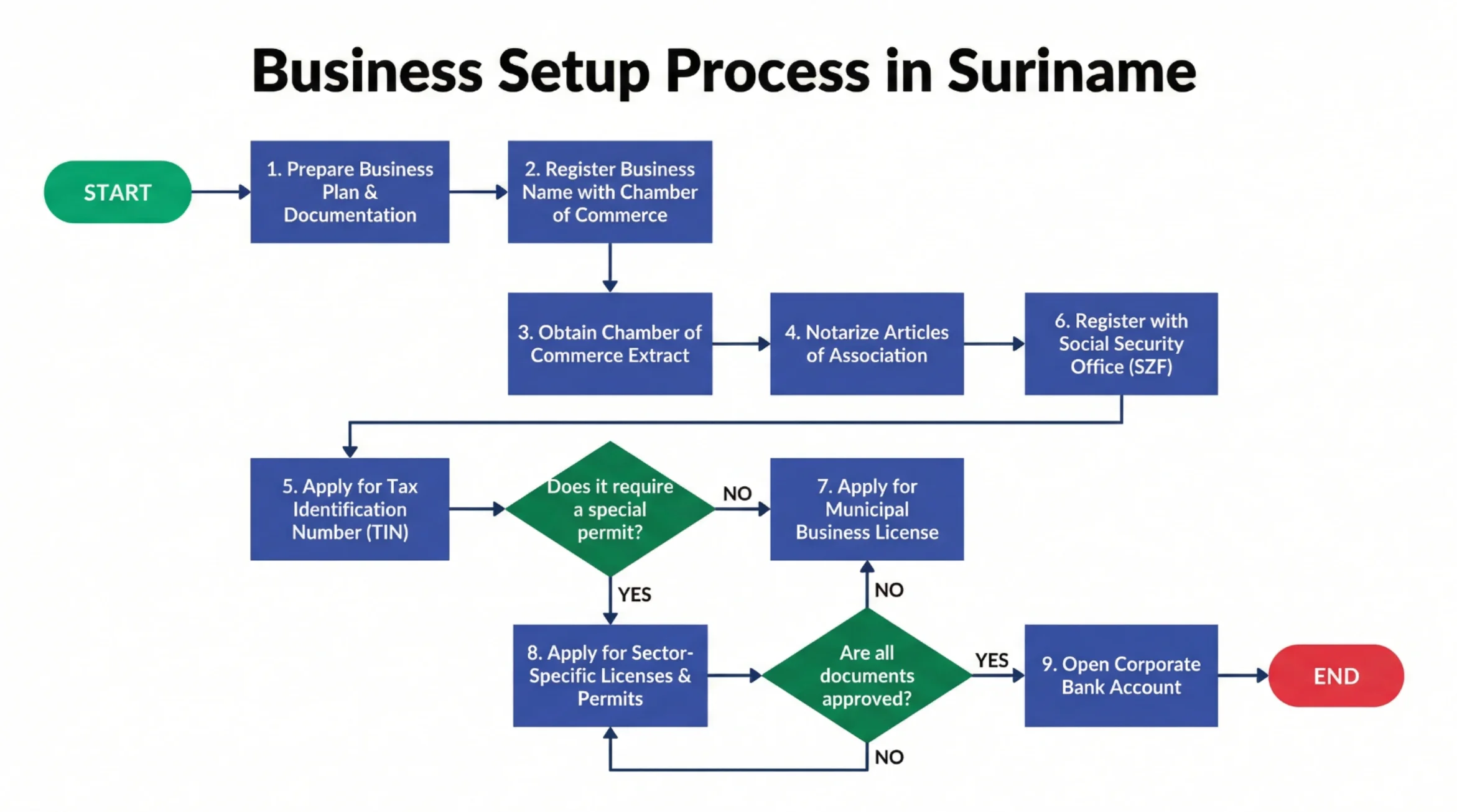
Step 1: Appoint a Local Representative

The initial step for a foreign investor is to appoint a local representative who is a resident of Suriname. This representative will act on behalf of the company during the initial registration phases.

Step 2: Secure Necessary Visas (if applicable)

If a local representative is not appointed and foreign personnel need to be on the ground, they must apply for the required visas to enter and operate in Suriname legally.

Step 3: Company Name and Legal Structure

Before official registration, a name check must be performed to ensure availability. Concurrently, the investor must decide on the most suitable legal structure for the business (e.g., a limited liability company (NV) or a sole proprietorship).

Step 4: Chamber of Commerce Registration

The business must be officially registered with the Suriname Chamber of Commerce and Industry (KKF). This is a mandatory step for legal recognition and operation.

Step 5 & 6: Licensing and Tax Registration

Following the Chamber of Commerce registration, the company must apply for all necessary business licenses and permits relevant to its specific industry. Subsequently, the company must register with the Tax Authorities to obtain a unique tax identification number.

Step 7, 8, & 9: Foreign Personnel Permits

For any foreign personnel, a separate process is initiated to secure their legal status. This involves:

  • Applying for a visa to enter the country.
  • Applying for a residence permit upon arrival.
  • Applying for a work permit, which is the final authorization required for foreign nationals to be legally employed in Suriname.

Once all these steps are completed, the investment process is concluded, and the business can operate in full compliance with Surinamese law.

Registering a business in Suriname is a straightforward process. The first step is to choose a unique business name and verify its availability through the Suriname Chamber of Commerce and Industry (KKF). The name must not be misleading or similar to existing trade names. For legal entities such as a Limited Liability Company (N.V.), the name must include the abbreviation ‘N.V.’.

The registration process involves submitting the required documents to the KKF. These typically include:

  • A completed application form
  • A notarial deed of incorporation (for N.V.s)
  • Proof of capital deposit
  • Identification documents of the founders/directors

Foreign investors can choose from several legal forms for their business, with the most common being the Naamloze Vennootschap (N.V.), which is a limited liability company. Other options include a sole proprietorship, a partnership, or a branch office of a foreign company.

Useful Links:

Suriname’s legal system is based on Dutch civil law. The country has a comprehensive legal framework to govern business and investment activities. Foreign investors are generally treated the same as local investors and are not subject to discriminatory practices.

Visa and Work Permits

Foreign investors and their employees who wish to work in Suriname must obtain the necessary visas and work permits. The process typically involves:

  • Business Visa: For short-term visits to explore investment opportunities, a business visa is required. This can often be obtained through an e-visa application process.
  • Work Permit: For long-term employment, a work permit is mandatory. The application is submitted to the Ministry of Labour and requires documentation such as an employment contract, diplomas, and a valid residence permit.
  • Residence Permit: Foreign nationals planning to reside in Suriname for an extended period must apply for a residence permit from the Ministry of Justice and Police.

Useful Links:

Environmental Regulations

Suriname has a strong commitment to environmental protection and sustainable development. The Environmental Framework Act and the Nature Conservation Act are the key pieces of legislation governing environmental management. The National Environmental Authority (NMA), formerly NIMOS, is the primary institution responsible for environmental impact assessments (EIAs) and ensuring compliance with environmental regulations. Investors in sectors such as mining, agriculture, and industry must adhere to these regulations and may be required to conduct an EIA before commencing their projects.

Useful Links:

Opening a corporate bank account is a crucial step for any business operating in Suriname. The process is generally straightforward, but requirements may vary slightly between banks. Foreign investors will typically need to provide the following documents:

  • Company registration documents from the KKF
  • Articles of incorporation
  • Valid identification for all directors and authorized signatories
  • Proof of address for the business and its directors

Suriname has a number of commercial banks that offer a range of services to businesses. The Central Bank of Suriname (CBvS) is the country’s monetary authority and supervises the financial sector.

Useful Links of Banking and Finance in Suriname:

Banks:


Insurance Companies:

Credit Union:

Central Bank of Suriname:

Suriname has a structured tax system, and the government offers various incentives to attract foreign investment. Understanding the tax landscape is crucial for financial planning and maximizing the return on your investment.

Corporate Taxation

The corporate income tax rate in Suriname is a flat 36%. This rate applies to both resident and non-resident companies with a branch in the country. Suriname also has a Value Added Tax (VAT) system, with a standard rate of 10% on most goods and services.

Investment Incentives

The Surinamese government provides a range of incentives to encourage investment, particularly in priority sectors. These incentives are outlined in the Investment Law and can include:

  • Tax Holidays: Qualifying investments may be eligible for a tax holiday of up to nine years, which can be extended for an additional year for large-scale projects.
  • Import Duty Exemptions: Investors can benefit from exemptions on customs duties and other import-related taxes for capital goods and raw materials.
  • VAT Exemptions: New investment projects may receive a zero-rating on VAT for specific goods and services procured locally during the setup phase.

Useful Links:

Suriname’s transportation infrastructure is strategically positioned to serve as a logistics hub for the Caribbean and South American regions. The country’s network of ports, airports, and roads provides essential connectivity for businesses engaged in manufacturing, agribusiness, mining, and energy sector operations. This section details the key transportation infrastructure available to investors.

Suriname’s port infrastructure is critical for import/export operations, particularly for agricultural products, minerals, and manufactured goods. The country has multiple port facilities capable of handling containerized cargo, bulk commodities, and specialized cargo.

Main Port Facilities


1. Port of Paramaribo:

The Port of Paramaribo is Suriname’s primary port and the busiest in the country. It is operated by DP World Paramaribo and handles the majority of the nation’s international trade.

Operational Capacity:

  • Annual container handling capacity: 130,000 twenty-foot equivalent units (TEUs)
  • Equipped with modern cargo handling equipment, including a Liebherr LHM 280 harbor crane with 84-ton lift capacity
  • Handles container vessels, general cargo ships, tankers, and bulk carriers
  • 24/7 operational capability


Services:

  • Container handling (import/export)
  • Bulk cargo operations
  • Tanker operations
  • Vessel repair and maintenance support
  • Customs clearance and documentation services


Contact Information:

DP World Paramaribo - Website: https://www.dpworld.com/en/suriname/ports-and-terminals/dp-world-paramaribo

2. Kuldipsingh Port Facility

Located in Wanica District, the Kuldipsingh Port Facility serves as a specialized port for offshore support operations and heavy cargo handling.

Operational Focus:

  • Offshore supply vessel (OSV) services
  • Mining and mineral cargo discharge
  • Oversized and project cargo handling
  • Round log loading for timber exports
  • Specialized equipment for deepwater operations


Strategic Importance:

The Kuldipsingh facility is particularly important for the oil and gas sector, providing dedicated infrastructure for offshore support operations and the movement of equipment and personnel to offshore installations.

Contact Information:

Kuldipsingh Port Facility N.V. - Website: https://kuldipsingh.net/en/kuldipsingh-port-facility/

Port Development and Future Expansion

The government of Suriname is investing in port infrastructure modernization and expansion to accommodate increased cargo volumes and larger vessels. These improvements are part of the broader strategy to position Suriname as a regional logistics hub for the Caribbean and South America.

Suriname’s airport infrastructure represents a strategic logistics advantage for investors in the oil and gas sector, offshore services, and executive business travel. The country’s position in the northeastern Caribbean, combined with direct regional air connectivity, creates a competitive advantage for time-sensitive operations and personnel mobility in the energy sector.

1. Johan Adolf Pengel International Airport (PBM)

Johan Adolf Pengel International Airport is Suriname’s primary international airport and the main gateway for international travel and cargo operations.

Location: Zandery, approximately 45 kilometers south of Paramaribo

IATA Code: PBM | ICAO Code: SMJP

Airport Facilities and Capacity

Terminal Infrastructure:

  • Modern single terminal handling both domestic and international flights
  • Capacity expansion planned: Phase 1 (2025) to handle 13-15 million passengers and 175,000 tons of cargo annually; Phase 2 (by 2030) for further expansion
  • 24-hour operations capability
  • Modern passenger amenities and business facilities


Cargo Facilities:

  • Dedicated cargo handling areas
  • Cold Storage Capacity: 5 cold chambers with total capacity of 51,000 kg, operational 24/7
  • Perishable cargo handling for agricultural exports (fruits, vegetables, seafood)
  • General cargo warehousing
  • Hazardous materials handling capability (relevant for oil and gas operations)


Ground Handling Services:

  • Premium ground handling services available through partnerships with international aviation service providers
  • Aircraft maintenance and refueling capabilities
  • VIP lounge and executive services

Airlines and International Connections

Current Carriers:

Airline

Key Destinations

Contact

Caribbean Airlines

Port of Spain (POS), Georgetown – Ogle (OGL), Georgetown – Cheddi Jagan (GEO)

(+597) 520034/0035 or (+868) 625-7200

Surinam Airways

Amsterdam (AMS), Aruba (AUA), Belem (BEL), Barbados (BGI), Curacao (CUR), Georgetown (GEO), Miami (MIA)

(+597) 432700

KLM Royal Dutch Airlines

Amsterdam (AMS)

(+31) 20 4747746

Copa Airlines

Panama City (PTY)

(+597) 880-0909

GOL Transportes Aereos

Belem (BEL)

(+55) 11 5504-4410

Fly All Ways

Cuba (CMW, HAV, SCU), Georgetown (GEO)

(+597) 430370

2. Eduard Alexander Gummels International Airport (EAX) – EAG Airport

Eduard Alexander Gummels International Airport (IATA: EAX, ICAO: SMEG) is Suriname’s newest and most strategically important airport for offshore oil and gas operations. Officially opened on March 24, 2025, EAG Airport represents a dedicated facility specifically designed to support the hydrocarbon industry and offshore services.

Location: Kwatta, north of Paramaribo (Gummelsweg)

IATA Code: EAX | ICAO Code: SMEG

Operational History:

EAG Airport evolved from the Gummels Heliport Paramaribo (established in 2015), which was the first dedicated heliport built in Suriname. As offshore oil and gas operations expanded, the facility was developed into a full international airport with a 1,200-meter runway, completed in 2025. The airport is operated by EAG Airport Management N.V., a sister company of Gum Air N.V. and Surinam Sky Farmers N.V.

Strategic Importance for Energy Sector:

EAG Airport is specifically designed to facilitate offshore helicopter operations and support the expanding oil and gas industry. The facility has become critical infrastructure for: 

  • Helicopter personnel transport to offshore platforms 
  • Equipment and supply logistics for offshore operations
  • Emergency evacuation and medical services
  • Crew rotations for offshore installations


Airport Infrastructure:

Runway: 

  • Length: 1,200 meters
  • Surface: Asphalt
  • Direction: 05/29 - Capable of accommodating regional aircraft and business jets


Facilities:
 

  • Multiple hangars (expanded from initial 1 hangar in 2015 to 4 hangars by 2025)
  • Passenger terminal
  • Helicopter operations facilities
  • Ground handling services
  • Refueling capabilities
  • Maintenance support


Helicopter Operations:

EAG Airport is the primary hub for helicopter operations in Suriname:

  • Annual Helicopter Traffic: Approximately 800 helicopter flights annually
  • Peak Operations: Up to 20 helicopter flights in a single day with 5 helicopters
  • Operators: Bristow Helicopters, Era Helicopters, Gum Air, OMNI Helicopters (Chevron operations), and others
  • Aircraft Types: AW139 helicopters, DHC-6 Twin Otters, Beechcraft 1900D, and other regional aircraft

Airlines and Services:

Gum Air operates scheduled and charter services from EAG Airport:

Service Type

Routes

Aircraft

Domestic Charters

All interior airfields in Suriname

Cessna 206, Cessna 208B Grand Caravan, DHC-6 Twin Otter

International Flights

Georgetown (Guyana), Port of Spain (Trinidad), Cayenne (French Guiana)

Beechcraft 1900D, DHC-6 Twin Otter

Helicopter Charters

Offshore platforms, regional destinations

Various helicopter types

Other Airlines and Operators:

  • Trans Guyana Airways: Regional and international service
  • Bristow Helicopters: Offshore support operations
  • Era Helicopters: Offshore and emergency services
  • OMNI Helicopters: Chevron offshore operations support
  • French Air Force (Armée de l’air et de l’Espace): Military and strategic operations


Cargo and Logistics:

EAG Airport supports cargo operations for offshore supply chains: 

  • Equipment and spare parts transport
  • Supplies for offshore installations
  • General cargo handling
  • Charter cargo services


Contact Information:


Services: Helicopter charters, scheduled flights, ground handling, maintenance

Strategic Advantage:

EAG Airport provides a dedicated, modern facility specifically designed for offshore operations, eliminating the need to share facilities with commercial aviation at the main international airport. This specialized infrastructure is critical for:

  • Operational Efficiency: Dedicated helicopter and offshore support operations
  • Safety: Facilities optimized for offshore emergency services and medical evacuations
  • Logistics: Streamlined cargo and equipment handling for offshore supply chains
  • Capacity: Reduces congestion at the main international airport, ensuring reliable access for critical offshore operations

The Guyana–Suriname Air Connection

The direct air connection between Suriname and Guyana represents a critical strategic asset for investors in the oil and gas sector and offshore services industry.

Relevance for Oil & Gas and Offshore Services:

  1. Personnel Mobility: The Guyana-Suriname air corridor facilitates rapid movement of specialized personnel, engineers, and management staff between the two countries’ offshore operations. This is particularly valuable given the significant oil and gas development occurring in both nations’ territorial waters.
  2. Regional Hub Positioning: Suriname’s airport serves as a logistics hub for the broader Caribbean and South American region. The direct Guyana connection enables efficient coordination of:
  • Offshore supply vessel (OSV) operations
  • Equipment and spare parts logistics
  • Emergency personnel deployment
  • Executive and technical oversight of regional operations
  1. Business Travel Efficiency: For companies operating in both Guyana and Suriname, the direct flight connection reduces travel time and complexity compared to routing through other Caribbean hubs. Flight duration is approximately 1 hour, compared to 4-6 hours via alternative routes.
  2. Offshore Services Support: The proximity and connectivity enable service providers (drilling contractors, subsea specialists, marine logistics companies) to efficiently support operations across both nations’ offshore blocks.
  3. International Connectivity: From Paramaribo, onward connections to major international hubs are available:
  • Amsterdam (AMS): Direct KLM service providing European connectivity
  • Miami (MIA): Direct Surinam Airways service providing North American connectivity
  • Port of Spain (POS): Caribbean hub connectivity
  • Panama City (PTY): Central American and Pacific region connectivity

Operational Advantages:

  • Time-Sensitive Operations: For emergency personnel deployment, critical equipment delivery, or urgent technical support, the direct Guyana connection eliminates delays associated with hub transfers.
  • Cost Efficiency: Direct regional connectivity reduces travel costs and time away from operations.
  • Supply Chain Logistics: The airport’s cargo facilities support the movement of equipment, spare parts, and supplies required for offshore operations.

Domestic Airports

Suriname has several smaller airports serving domestic routes and remote areas:

  • Zorg en Hoop Airport (ORG): Secondary international airport in Paramaribo
  • Lelydorp Airport (LDI): Serves the interior regions
  • Corantijn Airport (CRN): Serves the eastern border region
  • Multiple airstrips in remote areas for regional connectivity

Road Network

Suriname has a developing road network that connects major urban centers and production areas. The road infrastructure is concentrated primarily in the coastal region, where the majority of economic activity is located.

Road Categories:

  • Paved Roads: Main highways connecting Paramaribo to other coastal towns and interior regions
  • Unpaved Roads: Secondary roads serving agricultural areas and remote communities


Road Development Projects

The government is investing in road improvement and expansion projects to enhance connectivity between:

  • Urban centers and ports
  • Agricultural production areas and markets
  • Mining regions and processing facilities
  • Industrial parks and distribution centers

These infrastructure improvements are part of the broader strategy to support economic diversification and facilitate trade.

Transportation Logistics

For industrial and commercial operations, road transportation is used for:

  • Distribution of manufactured goods
  • Movement of agricultural products to ports and processing facilities
  • Supply chain logistics for mining and industrial operations
  • Personnel transportation

Infrastructure

Primary Use

Key Advantage

Contact

Port of Paramaribo

Container and general cargo

Modern facilities, 130,000 TEU capacity

DP World

Kuldipsingh Port

Offshore support, heavy cargo

Specialized for oil & gas operations

Kuldipsingh

J.A. Pengel Airport (PBM)

International air cargo and passengers

Direct Guyana connection, regional hub

JAPI

Road Network

Domestic distribution

Coastal connectivity

Ministry of Transport

  1. Early Coordination: Engage with port and airport operators early in project planning to ensure capacity availability and arrange specialized services.
  2. Cargo Planning: For perishable goods, utilize the airport’s 24/7 cold storage facilities to minimize spoilage and maintain product quality.
  3. Personnel Logistics: Leverage the Guyana-Suriname air connection for efficient personnel management in regional operations.
  4. Supply Chain Optimization: Coordinate with logistics providers to optimize routing through ports and airports based on product type and destination.

Infrastructure Investment: Monitor ongoing port and airport expansion projects, as these will enhance capacity and capabilities for future operations.

Access to reliable utilities is critical for manufacturing, logistics, agribusiness, and industrial operations in Suriname. This section provides practical guidance on obtaining water and electricity connections including processes, costs, timelines, and key requirements.

Service Provider:

N.V. Surinaamsche Waterleiding Maatschappij (SWM)

SWM is the state-owned water utility company responsible for water supply in Suriname’s urban areas, including Paramaribo, Wanica, Nieuw Nickerie, and Albina. The company provides potable water services to residential, commercial, and industrial customers.

Connection Process for Industrial and Commercial Users:

Step 1: Initial Application

Industrial and commercial entities must submit a connection application to SWM. The application process varies depending on whether you are establishing a new facility or require a connection for an existing building.

Required Documentation:

  • Completed application form (available at SWM customer service centers or downloadable from their website)
  • Copy of land parcel map (perceelkaart)
  • Copy of identification documents of the applicant or authorized company representative
  • Company registration documents from the Chamber of Commerce (KKF)
  • CBB address slip (proof of address)
  • Street name and building registration (BR) number
Step 2: Site Inspection and Quotation

After submitting the application, SWM conducts a site inspection to assess the feasibility of the connection and determine the scope of work required. Within three weeks of the application, SWM provides a quotation detailing the connection costs.

Step 3: Payment and Installation

Once the quotation is accepted and payment is made, SWM schedules the installation work. The installation timeline is typically a minimum of six weeks from the date of payment, depending on the complexity of the connection and site conditions.

Important: The work area must be cleared of vegetation and obstacles to facilitate installation.

Step 4: Internal Plumbing Installation

For commercial and industrial facilities, internal plumbing must be installed by a certified plumber recognized by SWM. The plumber prepares installation drawings and submits them to SWM for approval.

Step 5: Inspections

SWM conducts two inspections:

  • Interim Inspection: Before walls are sealed, to verify proper installation of internal plumbing.
  • Final Inspection: After completion of all plumbing work and installation of fixtures.

Inspection fees vary based on the distance from SWM facilities and must be paid in advance.

Step 6: Connection Activation

Upon successful completion of inspections and payment of all outstanding fees, SWM activates the water connection. The appropriate tariff is applied based on the customer category.

Water Connection Costs:

Connection costs are determined on a case-by-case basis and depend on factors such as:

  • Distance from the main water supply line
  • Pipe diameter required for industrial use
  • Site-specific infrastructure requirements


Deposit (Waarborgsom):

  • Commercial Connections: SRD 155
  • Public/Government Connections: SRD 150
  • Construction Tap (Temporary): SRD 155

Water Tariffs (Effective July 2025 - January 2026):

SWM operates a tiered tariff system based on customer category:

Tariff Group

Description

Rate per m³ (SRD)

40

Groundwater Tariff

100.00

41

Commercial Connections

75.00

42

Public Connections

41.81

60

Construction Tap

41.81

Note: The base tariff is SRD 41.81 per cubic meter, which represents the cost of producing one cubic meter of water. Commercial and industrial users pay a premium tariff to support the social pricing structure for residential customers.

Additional Costs:

  • Meter rental: Included in monthly billing
  • Inspection fees: Variable based on location

Timelines:

  • Application to Quotation: 3 weeks
  • Installation After Payment: Minimum 6 weeks
  • Total Process Duration: Approximately 9-12 weeks from initial application to connection activation

Capacity Considerations:

Industrial users requiring high-volume water supply should:

  • Specify anticipated water consumption in the application
  • Discuss capacity requirements with SWM during the site inspection
  • Consider installing on-site water storage tanks (durotanks) to ensure continuous supply during peak demand periods

For areas without SWM network coverage, bulk water delivery by tanker truck is available. Orders can be placed at SWM customer service locations, with delivery typically within three days of payment.

Key Requirements:

  • All internal plumbing must be installed by SWM-certified plumbers
  • Installation drawings must be approved by SWM before work commences
  • Facilities must pass both interim and final inspections
  • Payment of all connection fees and deposits before activation
  • Compliance with SWM connection standards and specifications

Service Provider:

N.V. Energiebedrijven Suriname (EBS)

EBS is the state-owned electricity utility responsible for power generation, transmission, and distribution throughout Suriname. The company serves residential, commercial, and industrial customers.

Connection Process for Industrial and Commercial Users:

Step 1: Preliminary Consultation

For large industrial loads, it is recommended to engage in preliminary discussions with EBS to assess grid capacity and feasibility. This is particularly important for manufacturing facilities, cold storage operations, and energy-intensive industries.

Step 2: Application Submission

Submit a formal connection application to EBS. Applications cannot currently be submitted online and must be delivered in person to EBS offices.

Required Documentation:

  • Completed connection application form
  • Company registration documents from the Chamber of Commerce (KKF)
  • Land title or lease agreement
  • Building permit (if applicable)
  • Electrical installation plans prepared by a licensed electrician
  • Proof of identification for authorized company representatives
  • Site plan showing the location of the proposed connection point
Step 3: Technical Assessment and Quotation

EBS conducts a technical assessment to determine:

  • Availability of grid capacity in the area
  • Required transformer capacity
  • Distance from the nearest distribution point
  • Infrastructure upgrades needed (if any)


Based on the assessment, EBS provides a quotation for connection costs, which may include:

  • Service line installation
  • Transformer installation or upgrade
  • Meter installation
  • Administrative fees
Step 4: Payment and Contract

Upon acceptance of the quotation, the applicant must:

  • Pay the connection fees
  • Sign an electricity supply agreement with EBS
  • Provide a security deposit (amount varies based on anticipated consumption)
Step 5: Internal Electrical Installation

The applicant must hire a licensed electrician to install the internal electrical system in accordance with EBS specifications and national electrical codes. The electrician submits the installation plans to EBS for approval.

Step 6: Inspection and Approval

Once the internal installation is complete, the electrician applies for an EBS inspection. An EBS inspector verifies that the installation meets safety standards and technical specifications.

Inspection Requirements:

  • Compliance with EBS technical standards
  • Proper grounding and earthing
  • Adequate circuit protection
  • Safe meter installation location
Step 7: Connection and Meter Installation

After successful inspection and approval, EBS schedules the connection and meter installation. The connection is typically completed within a few days of approval.

Connection Costs:

Connection costs for industrial and commercial users vary significantly based on:

  • Load requirements (kVA)
  • Voltage level (low voltage, medium voltage, or high voltage)
  • Distance from existing infrastructure
  • Need for dedicated transformers or substations

Indicative Cost Components:

  • Service Connection Fee: Variable (based on distance and infrastructure)
  • Transformer Installation: Required for medium and high-voltage connections
  • Meter Installation: Included in connection fee
  • Security Deposit: Typically equivalent to 2-3 months of estimated consumption

Note: For large industrial projects requiring significant grid upgrades, costs can be substantial and are determined on a project-specific basis.

Electricity Tariffs:

Suriname is transitioning to cost-reflective electricity tariffs. As of 2025, commercial and industrial tariffs have reached cost recovery levels.

Indicative Tariff Information:

  • Residential Rate (June 2025): SRD 2.280 per kWh (USD 0.060 per kWh)
  • Commercial/Industrial Rate (2019 data): USD 0.240 per kWh

Note: Tariffs are subject to periodic adjustment based on the cost of electricity production, which is influenced by fuel prices and generation mix. The Energy Authority of Suriname (EAS) regulates tariff structures.

Tariff Structure:

Electricity tariffs in Suriname typically consist of:

  • Base Tariff: Covers fixed costs of infrastructure and service
  • Consumption Tariff: Based on kilowatt-hours (kWh) consumed
  • Demand Charge: For large industrial users, based on peak demand (kVA or kW)

Timelines:

  • Application to Technical Assessment: 2-4 weeks
  • Quotation Preparation: 1-2 weeks
  • Internal Installation (by customer): Variable (depends on facility size and complexity)
  • Inspection and Approval: 1-2 weeks after application for inspection
  • Connection After Approval: 3-7 days
  • Total Process Duration: Approximately 8-16 weeks from initial application to energization (excluding internal installation time)

Note: Timelines can be longer for large industrial projects requiring grid upgrades or new transformer installations.

Capacity Considerations:

Industrial investors should carefully assess their power requirements:

  • Load Analysis: Determine peak demand (kW or kVA) and total energy consumption (kWh)
  • Voltage Level: Low-voltage connections (up to 1 kV) are suitable for small to medium operations. Large industrial facilities may require medium-voltage (10-20 kV) or high-voltage connections.
  • Grid Capacity: In some areas, grid capacity may be limited. Discuss with EBS early in the planning process.
  • Backup Power: Given occasional supply interruptions, industrial users should consider backup generation (diesel or renewable) for critical operations.
  • Power Quality: For sensitive manufacturing processes, power conditioning equipment may be necessary.

Key Requirements:

  • All electrical installations must be performed by licensed electricians
  • Installation plans must be approved by EBS before work begins
  • Installations must comply with EBS technical standards and national electrical codes
  • Successful inspection and approval required before connection
  • Payment of all connection fees and security deposits
  • Signed electricity supply agreement with EBS

Additional Considerations for Industrial Users:

Renewable Energy Integration:

Suriname is encouraging renewable energy development. Industrial users interested in on-site solar generation or other renewable sources should:

  • Contact the Energy Authority of Suriname (EAS) for regulations on distributed generation
  • Discuss grid interconnection requirements with EBS
  • Explore potential feed-in tariff arrangements for excess power

Energy Efficiency:

The government is promoting energy efficiency. Industrial users should consider:

  • Energy audits to identify efficiency opportunities
  • Investment in energy-efficient equipment (may qualify for incentives)
  • Demand-side management to reduce peak load charges

Utility

Service Provider

Application Timeline

Typical Connection Cost

Key Requirements

Water

SWM

9-12 weeks

Variable + SRD 155 deposit (commercial)

Certified plumber, site inspection, approved drawings, cleared work area

Electricity

EBS

8-16 weeks

Variable (load-dependent) + security deposit

Licensed electrician, approved plans, inspection, supply agreement

Water Supply:

N.V. Surinaamsche Waterleiding Maatschappij (SWM)

Electricity Supply:

N.V. Energiebedrijven Suriname (EBS)

  • Website: https://nvebs.com/
  • Contact: Information available through website and customer service centers

Regulatory Authority:

Energie Autoriteit Suriname (EAS)

  • Website: https://eas.sr/
  • Role: Regulation of the electricity sector, including tariffs, licensing, and renewable energy policy
  1. Early Engagement: Contact utility providers early in the project planning phase to assess availability, capacity, and timelines.
  2. Budget Adequately: Connection costs can be significant, especially for industrial loads. Obtain detailed quotations and budget for potential infrastructure upgrades.
  3. Plan for Delays: Allow buffer time in project schedules for utility connections, inspections, and approvals.
  4. Hire Qualified Contractors: Use only certified plumbers and licensed electricians recognized by SWM and EBS to avoid delays and ensure compliance.
  5. Consider Backup Systems: For critical operations, invest in backup water storage and power generation to mitigate supply interruptions.
  6. Explore Incentives: Investigate government incentives for energy efficiency and renewable energy integration.

Maintain Good Relations: Establish strong working relationships with utility providers for ongoing support and priority service.

Suriname’s workforce represents a diverse, multilingual talent pool with growing technical expertise in emerging sectors. The country’s labor market is characterized by a mix of skilled professionals, technical workers, and a growing pool of talent trained in energy, logistics, and manufacturing sectors. For investors, understanding how to effectively hire, manage compliance, and access recruitment resources is essential to building a productive workforce.


This section provides practical guidance on Suriname’s labor legislation, the role of government oversight, hiring procedures for both local and foreign workers, and a comprehensive directory of recruitment agencies organized by industry sector.

Legal Framework:

Suriname’s employment relationships are governed by the Labor Code of Suriname (in Dutch, Arbeidswet), which is the central legislation regulating employment relationships, working conditions, dispute resolution, and worker protections. The legal framework is designed to protect workers’ rights while providing employers with a clear operational structure.

Key Employment Law Provisions:

1. Employment Contracts

Contract Requirements: While written employment contracts are not compulsory under Surinamese law, they are highly recommended for clarity, legal protection, and dispute prevention. Written contracts should clearly outline key terms including job responsibilities, working hours, salary, benefits, and termination conditions.

Types of Contracts:

Permanent Contracts are open-ended agreements that continue until terminated by either party. These are the standard employment relationship for most positions.

Fixed-Term Contracts are agreements for a specific duration or to complete a particular task. Upon expiration, they either end or require renewal if both parties agree to continue the relationship.

Probationary Period: A probationary period is standard for permanent contracts and typically lasts 2 months. During this period, either party may terminate the employment relationship with shorter notice periods.

2. Working Hours and Overtime

Standard Working Hours: The standard workweek in Suriname is 40 hours, with a typical workday consisting of 8 hours. Employees generally work Monday to Friday, though variations exist depending on industry requirements.

Overtime Compensation: Work performed beyond standard working hours is classified as overtime and compensated at 1.5 times the normal hourly rate. Work performed on Sundays and public holidays is compensated at double the normal hourly rate (100% premium).

Overtime Regulations: Employers must ensure that overtime is properly documented, tracked, and compensated. Excessive overtime may be subject to regulatory scrutiny, and employers should maintain clear records of all overtime work.

3. Minimum Wage

National Minimum Wage: The government of Suriname establishes the national minimum wage, which applies across various sectors. As of 2025, the minimum wage is approximately SRD 2,200 per month, subject to periodic adjustments by government decree.

Wage Payment Requirements: Employers are required to pay wages at least monthly. Employees must receive a detailed pay slip that clearly shows gross pay, deductions (taxes, social security contributions), and net pay. Wage payments must be made on time and in full.

Sector Variations: Some sectors or industries may have negotiated collective bargaining agreements (CBAs) that establish higher wage floors or additional benefits beyond the national minimum.

4. Leave and Holiday Entitlements

Annual Leave: Employees who have completed one full year of employment are entitled to 15 days of paid annual leave per year. For employees with less than one year of service, leave accrues on a pro-rata basis (approximately 1.25 days per month).

Public Holidays: Suriname observes numerous public holidays, including New Year’s Day, Labor Day (May 1), Independence Day, and Christmas Day. When employees are required to work on a public holiday, they are entitled to either double pay or a compensatory day off in lieu.

Sick Leave: Employees are entitled to sick leave when medically unable to work. The first 2 days of sick leave are typically unpaid; however, for absences exceeding 2 days, employees may receive full pay or a portion of their salary depending on their employment contract or company policy. Medical certificates are generally required for sick leave exceeding 3 days.

Maternity Leave: Female employees are entitled to 12 weeks of paid maternity leave, which can be taken before or after childbirth. The leave is typically paid by the employer or through the country’s social security system (Algemene Sociale Verzekering - ASV).

Paternity Leave: While not mandated by law, some employers offer paternity leave on a voluntary basis.

5. Termination and Dismissal

Notice Periods: Both employers and employees must provide advance notice before terminating employment:

For employees with less than 5 years of service: The notice period is 1 month.

For employees with 5 or more years of service: The notice period increases to 2 months.

Grounds for Dismissal: Employees may be dismissed for various reasons, including serious misconduct, repeated poor performance, redundancy due to operational changes, or financial difficulties. However, dismissals must follow due process, be justified, and comply with labor law requirements.

Severance Pay: In cases of dismissal without cause or due to redundancy, employees are generally entitled to severance pay calculated based on their length of service and salary level. The severance calculation typically follows statutory formulas defined in labor law or collective bargaining agreements.

Wrongful Termination: Employees dismissed without just cause or in violation of labor law protections may file complaints with labor courts. Remedies may include reinstatement, back pay, or additional compensation.

6. Employee Rights and Protections

Non-Discrimination: Suriname’s employment laws prohibit discrimination based on gender, race, religion, disability, sexual orientation, national origin, or other protected characteristics. Employers must ensure equal treatment in hiring, promotion, compensation, and termination decisions.

Health and Safety: Employers are required to maintain a safe and healthy working environment that complies with occupational health and safety standards. This includes providing necessary safety equipment, training, and hazard prevention measures.

Workplace Harassment: Sexual harassment and other forms of workplace harassment are prohibited. Employees have the right to file complaints with their employer or relevant authorities if they experience harassment.

Union Rights: Workers have the right to join trade unions, engage in collective bargaining, and participate in union activities. Employers are prohibited from discriminating against employees based on union membership or activity.

7. Social Security and Benefits

Social Security Contributions: Both employees and employers are required to contribute to Suriname’s social security system (Algemene Sociale Verzekering - ASV). The system provides coverage for pensions, unemployment insurance, disability benefits, and medical insurance.

Employer Contributions: Employers typically contribute a percentage of employee wages to the social security system. The exact contribution rate is set by government regulation and may vary by sector.

Employee Contributions: Employees’ contributions are typically deducted from their wages and remitted to the ASV by the employer.

Pension Benefits: Employees are entitled to pension benefits upon retirement, calculated based on their contributions to the social security system during their working years.

Unemployment Benefits: Employees who lose their job may be eligible for unemployment benefits from the social security system for a limited period, subject to eligibility requirements.

1. Organizational Structure:

The Ministry of Labor, Employment Opportunity & Youth Affairs (Ministerie van Arbeid, Werkgelegenheid en Jeugdzaken - MAWJ) is the government agency responsible for labor administration, employment policy, and workplace compliance in Suriname.

2. Key Responsibilities:

Employment Regulation: The Ministry oversees the implementation and enforcement of labor laws, including employment contracts, working conditions, wage standards, and worker protections.

Work Permit Administration: The Ministry’s Labour Market Department and Work Permit Unit process and issue work permits for foreign nationals employed in Suriname.

Labor Dispute Resolution: The Ministry provides mechanisms for resolving disputes between employers and employees, including mediation and referral to labor courts.

Workplace Compliance: The Ministry conducts inspections and investigations to ensure employer compliance with labor laws, health and safety standards, and social security obligations.

Skills Development: The Ministry supports workforce development programs, vocational training, and apprenticeships to enhance the skills of Suriname’s labor force.

3. Contact Information

Ministry of Labor, Employment Opportunity & Youth Affairs

Labour Market Department - Work Permit Unit

  • Address: Dr. E. Brummelstraat 52-54, Paramaribo, Suriname
  • Phone: (+597) 472520
  • Email: workpermit@gmail.com

4. Work Permit Processing Timeline

Standard Processing: Work permit applications are typically processed within 30 days of submission, provided all required documentation is complete and accurate.

Extended Processing: If the application is incomplete or additional information is required, the Ministry may request clarification or additional documents, which can extend the processing timeline by an additional 30 days.

Expedited Processing: In some cases, expedited processing may be available for critical positions or time-sensitive projects, though this is subject to Ministry discretion.

1. Local Labor (Surinamese Citizens)

Hiring Requirements: Employers may hire Surinamese citizens without requiring work permits or special authorization. The standard employment contract and labor law provisions apply.

Advantages of Local Hiring:

  • No work permit requirements or associated costs
  • Familiarity with local business practices and culture
  • Established social security contributions through ASV
  • Support for local economic development and employment


Recruitment Process:
Employers can recruit local talent through direct hiring, recruitment agencies, job portals, or employee referrals. No government approval is required for local hiring decisions.

2. Foreign Labor (Non-Surinamese Nationals)

Work Permit Requirement: Every employer who wishes to employ a foreign national (non-Surinamese citizen) must obtain a work permit. The work permit is a mandatory requirement and must be secured before the foreign worker begins employment.

Work Permit Responsibility: The obligation to apply for and obtain the work permit rests with the employer, not the employee. The employer must initiate the application process and bear the associated costs.

Work Permit Application Process

Step 1: Prepare Documentation

The employer must compile the following documentation for submission to the Ministry of Labor:

  • Completed work permit application form (available from the Ministry of Labor)
  • Copy of the foreign worker’s passport (valid for at least 6 months)
  • Proof of the worker’s qualifications and professional credentials
  • Job description and contract of employment
  • Proof of the employer’s business registration and tax compliance
  • Evidence that the position cannot be filled by a qualified Surinamese worker
  • Medical certificate (health clearance)
  • Police clearance or background check (from the worker’s country of origin)


Step 2: Submit Application to Ministry of Labor

The employer submits the complete application package to the Ministry of Labor’s Work Permit Unit. Applications must be submitted in person or through authorized agents.

Step 3: Assessment and Review

The Ministry assesses whether the foreign worker possesses skills that are not readily available in the local workforce. The assessment considers:

  • The availability of qualified Surinamese workers for the position
  • The specialized nature of the skills required
  • The strategic importance of the position to the employer’s operations
  • The worker’s qualifications and experience


Step 4: Approval Decision

The Ministry issues a decision within the standard processing timeline. If approved, the employer receives a work permit authorization. If denied, the Ministry provides reasons for the denial.

Step 5: Work Permit Issuance

Upon approval, the foreign worker can proceed with obtaining the work permit from the Ministry or an authorized immigration office.

Work Permit Validity and Renewal

Validity Period: Work permits are typically valid for one year from the date of issuance.

Renewal: Work permits must be renewed annually if the employment relationship continues. Renewal applications should be submitted at least 30 days before the current permit expires.

Residency Requirement: Work permits do not automatically grant residency status. Foreign workers staying in Suriname for more than 90 days must also obtain a Temporary Residence Permit (MVK), which is initially valid for two years.

Work Permit Costs

Application Fee: The work permit application fee is typically USD 100-150, payable to the Ministry of Labor (subject to current fee schedules).

Processing Costs: Additional costs may apply for expedited processing or special circumstances.

Renewal Fee: Annual renewal fees apply and are similar to initial application fees.

Categories of Foreign Workers

Skilled Professionals: Foreign workers with specialized skills, professional qualifications, or technical expertise required for specific projects or positions.

Executives and Managers: Senior management and executive-level positions that require international experience or expertise.

Technical Specialists: Engineers, technicians, and specialists in energy, mining, logistics, and other specialized sectors.

Project Personnel: Workers contracted for specific time-limited projects in construction, energy, or other industries.

Intra-Company Transfers: Employees of multinational companies being transferred to Suriname operations.

Compliance and Obligations

Employer Obligations:

  • Maintain valid work permits for all foreign employees
  • Ensure foreign workers comply with all labor laws and regulations
  • Provide safe working conditions and appropriate compensation
  • Maintain accurate employment records and documentation
  • Report any changes in employment status or worker departure to the Ministry


Foreign Worker Obligations:

  • Work only for the employer specified in the work permit
  • Comply with all Surinamese labor laws and regulations
  • Maintain valid work and residency permits
  • Report any changes in employment or residence to immigration authorities

Suriname has a growing network of professional recruitment agencies specializing in different industry sectors. These agencies provide services ranging from candidate sourcing and screening to full employment administration and compliance support.

Energy & Oil & Gas Sector:

The energy sector is a primary focus for many recruitment agencies in Suriname, given the country’s expanding offshore oil and gas operations.

1. Airswift

Specialization: STEM employment, energy sector recruitment, oil and gas personnel

Services: 

  • Contract and direct hire recruiting for energy sector positions
  • Employer of Record (EOR) services for multinational energy companies
  • Global mobility and relocation services
  • Work permit and visa assistance
  • Payroll and employment administration

Sectors Served: Oil and gas, renewables, utilities, infrastructure

Geographic Reach: Suriname, Caribbean region, global operations

Contact Information: 


Notable Projects:
Total Energies Block 58 Field Development project support

2. Brunel

Specialization: Offshore and onshore oil and gas recruitment, vessel manning

Services: 

  • Recruitment for offshore oil and gas operations
  • Vessel crew recruitment and manning services
  • Global mobility and relocation
  • Compliance and employment administration


Sectors Served:
Oil and gas (offshore and onshore), maritime

Geographic Reach: South America, Caribbean, global operations

Contact Information: 

3. ORCA

Specialization: Offshore and maritime recruitment, crew services

Services: 

  • Recruitment and crew services for offshore operations
  • Maritime personnel placement
  • Project-based staffing
  • Compliance and regulatory support


Sectors Served:
Offshore oil and gas, maritime, marine services

Contact Information: 

4. EnergyJobs.sr

Specialization: Energy sector job portal, oil and gas employment

Services: 

  • Job portal for oil, gas, and energy industry positions
  • Candidate database and talent matching
  • Industry-focused recruitment


Sectors Served:
Oil and gas, energy, renewables

Contact Information: 

Logistics & Operations:

Recruitment agencies in the logistics sector focus on supply chain, warehouse operations, transportation, and port operations personnel.

1. SOGLASS (Suriname Oil & Gas Logistics and Sustainable Support)

Specialization: Logistics, supply chain, operations for oil and gas sector

Services: 

  • Recruitment services across industrial, clerical, commercial, and executive roles
  • Traineeships and apprenticeships
  • Supply chain and logistics personnel
  • Warehouse and operations staff
  • Compliance and employment administration


Sectors Served:
Oil and gas logistics, supply chain, operations, maritime

Contact Information: 

2. ASCO

Specialization: Supply chain operations, materials management, logistics

Services: 

  • Supply chain optimization
  • Materials management
  • Logistics and operations personnel
  • End-to-end supply chain solutions


Sectors Served:
Oil and gas, energy, industrial

Contact Information: 

3. Core Suriname

Specialization: Personnel solutions for project-based needs, craft labor

Services: 

  • Contract labor and staffing for projects
  • Craft labor and technical personnel
  • Direct hire and contract models
  • Project-based personnel solutions


Sectors Served:
Construction, industrial, manufacturing, projects

Contact Information: 

Manufacturing & Industrial:

Recruitment agencies serving manufacturing and industrial sectors focus on production, quality control, maintenance, and technical personnel.

1. Perfect Matching

Specialization: Administrative, HR, finance, IT/ICT, technical, and office-based roles

Services: 

  • Recruitment for administrative and professional roles
  • Technical and office-based personnel
  • Onsite and remote hiring options
  • Team extension services
  • Local and international recruitment


Sectors Served:
Administrative, HR, finance, IT/ICT, customer service, technical, manufacturing

Employment Models: Direct hire, staffing, contract labor

Geographic Reach: Suriname, Caribbean, Netherlands, Belgium, UK, US, Canada, EU

Contact Information: 

2. Atlas NextWave

Specialization: Recruitment, mobilization, compliance, payroll, workforce development

Services: 

  • Full-service recruitment and talent acquisition
  • Mobilization and deployment services
  • Compliance and regulatory support
  • Payroll and employment administration
  • Workforce development and training


Sectors Served:
Multiple sectors including energy, manufacturing, logistics

Contact Information: 

Professional and Administrative Services:

Recruitment agencies specializing in professional services focus on executive search, HR, finance, IT, and administrative personnel.

1. Perfect Matching 

Specialization: Administrative, HR, finance, IT/ICT, technical, and office-based roles

Services: 

  • Recruitment for administrative and professional roles
  • Technical and office-based personnel
  • Onsite and remote hiring options
  • Team extension services
  • Local and international recruitment


Sectors Served:
Administrative, HR, finance, IT/ICT, customer service, technical, manufacturing

Employment Models: Direct hire, staffing, contract labor

Geographic Reach: Suriname, Caribbean, Netherlands, Belgium, UK, US, Canada, EU

Contact Information: 

2. Remote People

Specialization: Executive search, headhunting, professional recruitment

Services: 

  • Executive search and headhunting
  • Professional recruitment services
  • Talent acquisition for specialized roles
  • International recruitment


Sectors Served:
Multiple sectors, with focus on professional and executive roles

Geographic Reach: Suriname, global operations

Contact Information: 

Agency

Primary Sectors

Services

Employment Models

Geographic Reach

Airswift

Energy, Oil & Gas, STEM

Contract recruiting, EOR, Global Mobility

Contract, Permanent, EOR

Suriname, Caribbean, Global

Brunel

Oil & Gas, Maritime

Offshore recruitment, Vessel manning, Mobility

Contract, Permanent

South America, Caribbean, Global

ORCA

Offshore, Maritime

Crew services, Offshore recruitment

Contract, Permanent

Suriname, Regional, Global

SOGLASS

Logistics, Oil & Gas

Recruitment, Traineeships, Supply Chain

Contract, Permanent, Traineeships

Suriname, Regional

ASCO

Supply Chain, Oil & Gas

Materials management, Logistics personnel

Contract, Permanent

Suriname, Regional

Core Suriname

Construction, Industrial, Projects

Craft labor, Project staffing

Contract, Permanent

Suriname, Regional

Perfect Matching

Admin, HR, Finance, IT, Technical

Direct hire, Staffing, Team extension

Contract, Permanent, Remote

Suriname, Caribbean, International

Atlas NextWave

Multi-sector

Recruitment, Mobilization, Compliance, Payroll

Contract, Permanent, EOR

Suriname, Regional

Remote People

Professional Services, Executive

Executive search, Headhunting

Permanent, Executive

Suriname, Global

For Local (Surinamese) Workers:

Step 1: Define Position Requirements

  • Clearly define job responsibilities, required qualifications, and experience level
  • Determine salary range based on market rates and minimum wage requirements
  • Identify any specific skills or certifications needed


Step 2: Source Candidates

  • Post job openings on local job portals and recruitment agency websites
  • Contact recruitment agencies specializing in your industry
  • Use employee referral programs
  • Advertise through local media or professional networks


Step 3: Screen and Interview

  • Review applications and screen candidates based on qualifications
  • Conduct interviews to assess fit and capabilities
  • Verify credentials and references


Step 4: Make Offer and Prepare Contract

  • Extend job offer with clear terms (salary, benefits, start date)
  • Prepare written employment contract outlining job responsibilities, working hours, compensation, leave entitlements, and termination conditions
  • Ensure contract complies with Surinamese labor law


Step 5: Onboarding and Compliance

  • Register employee with social security system (ASV)
  • Set up payroll and tax withholding
  • Provide workplace orientation and training
  • Maintain employment records

For Foreign Workers

Step 1: Define Position and Justify Need

  • Clearly define the position and required qualifications
  • Document why the position cannot be filled by a qualified Surinamese worker
  • Identify the specialized skills required


Step 2: Source Candidates

  • Contact international recruitment agencies (Airswift, Brunel, ORCA for energy sector)
  • Use industry-specific job portals
  • Leverage professional networks and industry associations


Step 3: Screen and Interview

  • Review applications and verify qualifications
  • Conduct interviews (can be conducted remotely)
  • Verify professional credentials and references
  • Request medical clearance and background check


Step 4: Prepare Work Permit Application

  • Compile required documentation (passport, qualifications, job contract, employer registration, etc.)
  • Prepare job description and employment contract
  • Gather medical certificate and police clearance
  • Ensure all documents are complete and accurate


Step 5: Submit Work Permit Application

  • Submit application package to Ministry of Labor’s Work Permit Unit
  • Pay application fee (USD 100-150)
  • Allow 30 days for standard processing
  • Follow up with Ministry if needed


Step 6: Obtain Work Permit

  • Upon approval, foreign worker obtains work permit from Ministry or immigration office
  • If staying longer than 90 days, worker must also apply for Temporary Residence Permit (MVK)


Step 7: Onboarding and Compliance

  • Register employee with social security system (ASV)
  • Set up payroll and tax withholding
  • Ensure worker has valid work and residency permits
  • Provide workplace orientation
  • Maintain employment records and work permit documentation
  1. Engage Recruitment Agencies Early: For specialized positions or foreign hiring, engage recruitment agencies early in the process. They can expedite candidate sourcing and handle compliance requirements.
  2. Prepare Comprehensive Job Descriptions: Clear, detailed job descriptions help recruitment agencies identify suitable candidates and reduce hiring time.
  3. Budget for Work Permits: Factor work permit costs and processing time into project timelines and budgets.
  4. Use Written Contracts: Always use written employment contracts that clearly outline terms, conditions, and expectations.
  5. Comply with Labor Laws: Ensure all hiring practices and employment terms comply with Surinamese labor law, including minimum wage, working hours, leave entitlements, and social security contributions.
  6. Maintain Documentation: Keep comprehensive employment records, including contracts, work permits, payroll records, and compliance documentation.
  7. Leverage Local Talent: Prioritize hiring local workers where possible to support community development and reduce work permit costs.
  8. Plan for Succession: Develop workforce development and training programs to build local capacity and reduce long-term dependence on foreign workers.

Foreign investors operating in Suriname must comply with a comprehensive regulatory framework covering business registration, taxation, labor, environmental protection, financial reporting, and sector-specific regulations. While compliance is addressed throughout this guide in different sections, this section specifically outlines the key compliance areas investors must address to operate legally and successfully in Suriname.

Company Registration

  • Register with the Chamber of Commerce and Industry (KKF) as a mandatory requirement
  • Obtain a Tax Identification Number (TIN) from the Ministry of Finance
  • Register with Social Security (ASV) for employee contributions
  • Obtain necessary sector-specific licenses and permits depending on industry
  • File incorporation documents with the appropriate government authority

Documentation Requirements

  • Maintain accurate business records and accounting books
  • Keep documentation in Dutch or English (official language requirement)
  • Preserve records for minimum 5 years for audit and inspection purposes
  • Ensure all contracts comply with Surinamese law

Corporate Income Tax

  • Standard rate: 25% on corporate profits
  • Filing requirement: Annual tax returns due within specified deadlines
  • Estimated tax payments: Quarterly advance payments required
  • Deductions: Allowable business expenses, depreciation, and investment deductions
  • Tax incentives: Available for qualifying sectors (10-year exemptions for BPO, renewable energy, etc.)

Value-Added Tax (VAT)

  • Standard rate: 10% on goods; 8% on services
  • Registration threshold: Mandatory for businesses exceeding revenue thresholds
  • Filing: Monthly or quarterly VAT returns required
  • Input tax credits: Available for VAT paid on business purchases
  • Compliance: Maintain detailed records of all transactions

Payroll and Wage Tax

  • Employee withholding: Mandatory income tax withholding from employee salaries
  • Employer contributions: Social security contributions (ASV) paid by employee (not employer)
  • Reporting: Monthly payroll tax filings required
  • Records: Maintain payroll documentation and employee records

Import/Export Taxes

  • Tariffs: Applicable on imported goods (rates vary by product classification)
  • Customs compliance: Proper documentation and declarations required
  • Duty payments: Must be paid before goods are cleared
  • Exemptions: Available for certain investment-related imports (subject to approval)

Employment Contracts

  • Written contracts: Required for all employees (local and foreign)
  • Language: Contracts must be in Dutch or clearly translated
  • Terms: Must include compensation, benefits, working hours, and termination conditions
  • Compliance: Must conform to Surinamese Labor Code requirements

Work Permits for Foreign Employees

  • Requirement: Foreign nationals must obtain work permits from the Ministry of Labor
  • Application: Employer must apply on behalf of foreign employee
  • Processing time: 4-8 weeks typical processing period
  • Documentation: Passport, employment contract, proof of qualifications required
  • Renewal: Work permits require periodic renewal (typically annually)

Minimum Wage and Compensation

  • Minimum wage: Approximately SRD 2,200/month (approximately USD 60/month as of 2025)
  • Payment frequency: Wages must be paid regularly (typically monthly)
  • Overtime: Overtime compensation at 1.5x regular rate; 2x for Sundays and holidays
  • Benefits: Mandatory social security contributions, annual leave, sick leave

Leave and Working Hours

  • Standard week: 40 hours maximum
  • Annual leave: Minimum 15 days per year
  • Sick leave: Paid sick leave available (employer covers first 3 days)
  • Maternity leave: Paid leave available for pregnant employees
  • Public holidays: 12 public holidays per year (paid)

Health and Safety

  • Workplace safety: Employers must maintain safe working conditions
  • Insurance: Mandatory workers’ compensation insurance required
  • Accident reporting: Work-related accidents must be reported to authorities
  • Inspections: Labor inspectors may conduct workplace inspections

Union and Labor Relations

  • Union rights: Employees have right to organize and join unions
  • Collective bargaining: Collective labor agreements may apply in certain sectors
  • Dispute resolution: Labor disputes handled through labor courts or arbitration

Environmental Impact Assessment (EIA)

  • Requirement: Large projects require Environmental Impact Assessment approval
  • Responsible agency: National Institute for Environment and Development (NIMOS)
  • Scope: Covers air quality, water, waste, biodiversity, and community impact
  • Approval: Must obtain environmental clearance before operations begin

Waste Management

  • Waste disposal: Must comply with waste management regulations
  • Hazardous waste: Special handling and disposal requirements for hazardous materials
  • Reporting: Maintain records of waste generation and disposal
  • Permits: May require waste disposal permits for industrial operations

Water and Air Quality

  • Water usage: Obtain permits for significant water consumption
  • Discharge: Industrial wastewater must meet quality standards before discharge
  • Air emissions: Comply with air quality standards; may require emission permits
  • Monitoring: Regular monitoring and reporting may be required

Environmental Permits and Licenses

  • Mining operations: Require environmental permits and ongoing compliance monitoring
  • Oil and gas: Subject to stringent environmental regulations and monitoring
  • Agriculture: Pesticide and chemical use must comply with regulations
  • Renewable energy: Environmental compliance required for all projects

Forest and Land Protection

  • Forest protection: Suriname protects 90% of forests; logging requires permits
  • Indigenous lands: Respect for indigenous land rights and consultation requirements
  • Biodiversity: Protection of endangered species and ecosystems mandatory

Annual Financial Statements

  • Requirement: All businesses must prepare annual financial statements
  • Standards: Must comply with International Financial Reporting Standards (IFRS) or local standards
  • Audit: Large companies may require independent audits
  • Filing: Statements must be filed with relevant authorities within specified timeframes

Bank Account and Financial Records

  • Bank account: Required for business operations
  • Record keeping: Maintain detailed financial records for minimum 5 years
  • Documentation: All transactions must be documented and traceable
  • Reconciliation: Regular bank reconciliation required

Transfer Pricing

  • Documentation: Required for related-party transactions
  • Compliance: Must comply with arm’s length principle
  • Reporting: Transfer pricing documentation may be required for tax purposes

Oil and Gas Sector

  • Production Sharing Contracts (PSCs): Compliance with contract terms mandatory
  • Local content: Preference for local goods and services at competitive prices
  • Environmental: Stringent environmental monitoring and reporting required
  • Licensing: Operated through Staatsolie (state-owned company)

Mining Sector

  • Mining permits: Required from Ministry of Natural Resources
  • Environmental compliance: Stringent EIA and ongoing monitoring required
  • Royalties: Royalty payments to government on mineral extraction
  • Community relations: Engagement with local communities required

BPO and Technology Sector

  • Data protection: Compliance with data privacy regulations
  • Intellectual property: Protection of IP rights; WIPO member protections apply
  • Cybersecurity: Implement appropriate cybersecurity measures
  • Tax incentives: Compliance with incentive program requirements for 10-year exemption

Agriculture and Agribusiness

  • Agricultural permits: May require permits for certain agricultural activities
  • Pesticide compliance: Proper handling and documentation of pesticide use
  • Export compliance: Compliance with export standards and certifications
  • Land use: Compliance with zoning and land use regulations

Anti-Corruption Laws

  • Bribery prohibition: Strictly prohibited; criminal penalties apply
  • Transparency: Maintain transparent business practices
  • Record keeping: Document all business transactions and dealings
  • Reporting: Report suspicious activities to appropriate authorities

Money Laundering Prevention

  • AML compliance: Comply with anti-money laundering regulations
  • Customer due diligence: Know Your Customer (KYC) requirements for financial transactions
  • Reporting: Report suspicious transactions to Financial Intelligence Unit (FIU)
  • Documentation: Maintain records of customer identification and transaction verification

Sanctions Compliance

  • International sanctions: Comply with international sanctions regimes
  • Screening: Screen business partners and transactions against sanctions lists
  • Documentation: Maintain compliance documentation

Trademark and Patent Registration

  • WIPO membership: Suriname is member of World Intellectual Property Organization
  • Registration: Register trademarks and patents for protection
  • Enforcement: Pursue legal action against IP infringement
  • Documentation: Maintain IP documentation and licensing agreements

Copyright Protection

  • Berne Convention: Suriname signatory to Berne Convention for literary and artistic works
  • Protection: Automatic copyright protection for original works
  • Enforcement: Legal remedies available for copyright infringement


Mandatory Insurance

  • Workers’ compensation: Mandatory for all employers
  • Liability insurance: Recommended for business operations
  • Property insurance: Recommended for business assets
  • Vehicle insurance: Mandatory for company vehicles


Foreign Employee Requirements

  • Work permits: Required for foreign nationals (see Section 3 above)
  • Residency: May require residency permits for long-term stays
  • Documentation: Maintain employee immigration documentation
  • Compliance: Ensure all foreign employees have valid work authorization


Contract Enforcement

  • Jurisdiction: Disputes typically handled in Surinamese courts
  • Arbitration: New York Convention signatory; international arbitration available
  • Legal representation: Engage qualified local legal counsel for contracts
  • Documentation: Maintain clear, written contracts with dispute resolution clauses

Regulatory Compliance Monitoring

  • Inspections: Government agencies may conduct compliance inspections
  • Audits: Tax audits and financial audits may occur
  • Penalties: Non-compliance may result in fines, license suspension, or criminal penalties
  • Remediation: Address compliance issues promptly


Government Agencies

Ministry of Finance
Tax compliance and financial reporting
https://www.minfin.gov.sr/

Ministry of Labor, Employment Opportunity & Youth Affairs
Labor compliance and work permits
Phone: +597 402 800

Chamber of Commerce and Industry (KKF)
Business registration and compliance support
https://www.kkfsur.sr/

National Institute for Environment and Development (NIMOS)
Environmental compliance and permits
https://www.nimos.sr/

Suriname Investment and Trade Agency (SITA)
Investment support and regulatory guidance
https://sita.sr/

Central Bank of Suriname (CBvS)
Financial sector regulation and foreign exchange
https://www.cbvs.sr/

  • Engage local legal counsel: Retain qualified Surinamese legal advisors familiar with local regulations
  • Maintain detailed records: Keep comprehensive documentation of all business activities
  • Stay informed: Monitor regulatory changes and updates from government agencies
  • Proactive compliance: Address compliance issues before they become problems
  • Regular audits: Conduct internal compliance audits and financial reviews
  • Employee training: Ensure employees understand compliance requirements
  • Clear policies: Establish written compliance policies and procedures
  • Government liaison: Maintain regular communication with relevant government agencies
  • Professional advisors: Engage accountants, tax advisors, and compliance specialists
  • Documentation: Maintain organized, accessible compliance documentation

This document provides a comprehensive overview of the key steps involved in the investment process in Suriname, from initial setup to operational compliance. The process ensures that both local and foreign investors can navigate the legal and regulatory landscape efficiently.

Step 1: Appoint a Local Representative

The initial step for a foreign investor is to appoint a local representative who is a resident of Suriname. This representative will act on behalf of the company during the initial registration phases.

Step 2: Secure Necessary Visas (if applicable)

If a local representative is not appointed and foreign personnel need to be on the ground, they must apply for the required visas to enter and operate in Suriname legally.

Step 3: Company Name and Legal Structure

Before official registration, a name check must be performed to ensure availability. Concurrently, the investor must decide on the most suitable legal structure for the business (e.g., a limited liability company (NV) or a sole proprietorship).

Step 4: Chamber of Commerce Registration

The business must be officially registered with the Suriname Chamber of Commerce and Industry (KKF). This is a mandatory step for legal recognition and operation.

Step 5 & 6: Licensing and Tax Registration

Following the Chamber of Commerce registration, the company must apply for all necessary business licenses and permits relevant to its specific industry. Subsequently, the company must register with the Tax Authorities to obtain a unique tax identification number.

Step 7, 8, & 9: Foreign Personnel Permits

For any foreign personnel, a separate process is initiated to secure their legal status. This involves:

  • Applying for a visa to enter the country.
  • Applying for a residence permit upon arrival.
  • Applying for a work permit, which is the final authorization required for foreign nationals to be legally employed in Suriname.

Once all these steps are completed, the investment process is concluded, and the business can operate in full compliance with Surinamese law.

Registering a business in Suriname is a straightforward process. The first step is to choose a unique business name and verify its availability through the Suriname Chamber of Commerce and Industry (KKF). The name must not be misleading or similar to existing trade names. For legal entities such as a Limited Liability Company (N.V.), the name must include the abbreviation ‘N.V.’.

The registration process involves submitting the required documents to the KKF. These typically include:

  • A completed application form
  • A notarial deed of incorporation (for N.V.s)
  • Proof of capital deposit
  • Identification documents of the founders/directors

Foreign investors can choose from several legal forms for their business, with the most common being the Naamloze Vennootschap (N.V.), which is a limited liability company. Other options include a sole proprietorship, a partnership, or a branch office of a foreign company.

Useful Links:

Suriname’s legal system is based on Dutch civil law. The country has a comprehensive legal framework to govern business and investment activities. Foreign investors are generally treated the same as local investors and are not subject to discriminatory practices.

Visa and Work Permits

Foreign investors and their employees who wish to work in Suriname must obtain the necessary visas and work permits. The process typically involves:

  • Business Visa: For short-term visits to explore investment opportunities, a business visa is required. This can often be obtained through an e-visa application process.
  • Work Permit: For long-term employment, a work permit is mandatory. The application is submitted to the Ministry of Labour and requires documentation such as an employment contract, diplomas, and a valid residence permit.
  • Residence Permit: Foreign nationals planning to reside in Suriname for an extended period must apply for a residence permit from the Ministry of Justice and Police.

Useful Links:

Environmental Regulations

Suriname has a strong commitment to environmental protection and sustainable development. The Environmental Framework Act and the Nature Conservation Act are the key pieces of legislation governing environmental management. The National Environmental Authority (NMA), formerly NIMOS, is the primary institution responsible for environmental impact assessments (EIAs) and ensuring compliance with environmental regulations. Investors in sectors such as mining, agriculture, and industry must adhere to these regulations and may be required to conduct an EIA before commencing their projects.

Useful Links:

Opening a corporate bank account is a crucial step for any business operating in Suriname. The process is generally straightforward, but requirements may vary slightly between banks. Foreign investors will typically need to provide the following documents:

  • Company registration documents from the KKF
  • Articles of incorporation
  • Valid identification for all directors and authorized signatories
  • Proof of address for the business and its directors

Suriname has a number of commercial banks that offer a range of services to businesses. The Central Bank of Suriname (CBvS) is the country’s monetary authority and supervises the financial sector.

Useful Links of Banking and Finance in Suriname:

Banks:


Insurance Companies:

Credit Union:

Central Bank of Suriname:

Suriname has a structured tax system, and the government offers various incentives to attract foreign investment. Understanding the tax landscape is crucial for financial planning and maximizing the return on your investment.

Corporate Taxation

The corporate income tax rate in Suriname is a flat 36%. This rate applies to both resident and non-resident companies with a branch in the country. Suriname also has a Value Added Tax (VAT) system, with a standard rate of 10% on most goods and services.

Investment Incentives

The Surinamese government provides a range of incentives to encourage investment, particularly in priority sectors. These incentives are outlined in the Investment Law and can include:

  • Tax Holidays: Qualifying investments may be eligible for a tax holiday of up to nine years, which can be extended for an additional year for large-scale projects.
  • Import Duty Exemptions: Investors can benefit from exemptions on customs duties and other import-related taxes for capital goods and raw materials.
  • VAT Exemptions: New investment projects may receive a zero-rating on VAT for specific goods and services procured locally during the setup phase.

Useful Links:

Suriname’s transportation infrastructure is strategically positioned to serve as a logistics hub for the Caribbean and South American regions. The country’s network of ports, airports, and roads provides essential connectivity for businesses engaged in manufacturing, agribusiness, mining, and energy sector operations. This section details the key transportation infrastructure available to investors.

Ports

Suriname’s port infrastructure is critical for import/export operations, particularly for agricultural products, minerals, and manufactured goods. The country has multiple port facilities capable of handling containerized cargo, bulk commodities, and specialized cargo.

Main Port Facilities

1. Port of Paramaribo:

The Port of Paramaribo is Suriname’s primary port and the busiest in the country. It is operated by DP World Paramaribo and handles the majority of the nation’s international trade.

Operational Capacity:

  • Annual container handling capacity: 130,000 twenty-foot equivalent units (TEUs)
  • Equipped with modern cargo handling equipment, including a Liebherr LHM 280 harbor crane with 84-ton lift capacity
  • Handles container vessels, general cargo ships, tankers, and bulk carriers
  • 24/7 operational capability


Services:

  • Container handling (import/export)
  • Bulk cargo operations
  • Tanker operations
  • Vessel repair and maintenance support
  • Customs clearance and documentation services

Contact Information:

DP World Paramaribo - Website: https://www.dpworld.com/en/suriname/ports-and-terminals/dp-world-paramaribo

2. Kuldipsingh Port Facility

Located in Wanica District, the Kuldipsingh Port Facility serves as a specialized port for offshore support operations and heavy cargo handling.

Operational Focus:

  • Offshore supply vessel (OSV) services
  • Mining and mineral cargo discharge
  • Oversized and project cargo handling
  • Round log loading for timber exports
  • Specialized equipment for deepwater operations


Strategic Importance:

The Kuldipsingh facility is particularly important for the oil and gas sector, providing dedicated infrastructure for offshore support operations and the movement of equipment and personnel to offshore installations.

Contact Information:

Kuldipsingh Port Facility N.V. - Website: https://kuldipsingh.net/en/kuldipsingh-port-facility/

Port Development and Future Expansion

The government of Suriname is investing in port infrastructure modernization and expansion to accommodate increased cargo volumes and larger vessels. These improvements are part of the broader strategy to position Suriname as a regional logistics hub for the Caribbean and South America.

Airports

Suriname’s airport infrastructure represents a strategic logistics advantage for investors in the oil and gas sector, offshore services, and executive business travel. The country’s position in the northeastern Caribbean, combined with direct regional air connectivity, creates a competitive advantage for time-sensitive operations and personnel mobility in the energy sector.

1. Johan Adolf Pengel International Airport (PBM)

Johan Adolf Pengel International Airport is Suriname’s primary international airport and the main gateway for international travel and cargo operations.

Location: Zandery, approximately 45 kilometers south of Paramaribo

IATA Code: PBM | ICAO Code: SMJP

  1. Airport Facilities and Capacity

Terminal Infrastructure:

  • Modern single terminal handling both domestic and international flights
  • Capacity expansion planned: Phase 1 (2025) to handle 13-15 million passengers and 175,000 tons of cargo annually; Phase 2 (by 2030) for further expansion
  • 24-hour operations capability
  • Modern passenger amenities and business facilities


Cargo Facilities:

  • Dedicated cargo handling areas
  • Cold Storage Capacity: 5 cold chambers with total capacity of 51,000 kg, operational 24/7
  • Perishable cargo handling for agricultural exports (fruits, vegetables, seafood)
  • General cargo warehousing
  • Hazardous materials handling capability (relevant for oil and gas operations)


Ground Handling Services:

  • Premium ground handling services available through partnerships with international aviation service providers
  • Aircraft maintenance and refueling capabilities
  • VIP lounge and executive services
Airlines and International Connections

Current Carriers:

Airline

Key Destinations

Contact

Caribbean Airlines

Port of Spain (POS), Georgetown – Ogle (OGL), Georgetown – Cheddi Jagan (GEO)

(+597) 520034/0035 or (+868) 625-7200

Surinam Airways

Amsterdam (AMS), Aruba (AUA), Belem (BEL), Barbados (BGI), Curacao (CUR), Georgetown (GEO), Miami (MIA)

(+597) 432700

KLM Royal Dutch Airlines

Amsterdam (AMS)

(+31) 20 4747746

Copa Airlines

Panama City (PTY)

(+597) 880-0909

GOL Transportes Aereos

Belem (BEL)

(+55) 11 5504-4410

Fly All Ways

Cuba (CMW, HAV, SCU), Georgetown (GEO)

(+597) 430370


2. Eduard Alexander Gummels International Airport (EAX) – EAG Airport

Eduard Alexander Gummels International Airport (IATA: EAX, ICAO: SMEG) is Suriname’s newest and most strategically important airport for offshore oil and gas operations. Officially opened on March 24, 2025, EAG Airport represents a dedicated facility specifically designed to support the hydrocarbon industry and offshore services.

Location: Kwatta, north of Paramaribo (Gummelsweg)

IATA Code: EAX | ICAO Code: SMEG

Operational History:

EAG Airport evolved from the Gummels Heliport Paramaribo (established in 2015), which was the first dedicated heliport built in Suriname. As offshore oil and gas operations expanded, the facility was developed into a full international airport with a 1,200-meter runway, completed in 2025. The airport is operated by EAG Airport Management N.V., a sister company of Gum Air N.V. and Surinam Sky Farmers N.V.

Strategic Importance for Energy Sector:

EAG Airport is specifically designed to facilitate offshore helicopter operations and support the expanding oil and gas industry. The facility has become critical infrastructure for: 

  • Helicopter personnel transport to offshore platforms 
  • Equipment and supply logistics for offshore operations
  • Emergency evacuation and medical services
  • Crew rotations for offshore installations


Airport Infrastructure:

Runway: 

  • Length: 1,200 meters
  • Surface: Asphalt
  • Direction: 05/29 - Capable of accommodating regional aircraft and business jets


Facilities:
 

  • Multiple hangars (expanded from initial 1 hangar in 2015 to 4 hangars by 2025)
  • Passenger terminal
  • Helicopter operations facilities
  • Ground handling services
  • Refueling capabilities
  • Maintenance support


Helicopter Operations:

EAG Airport is the primary hub for helicopter operations in Suriname:

  • Annual Helicopter Traffic: Approximately 800 helicopter flights annually
  • Peak Operations: Up to 20 helicopter flights in a single day with 5 helicopters
  • Operators: Bristow Helicopters, Era Helicopters, Gum Air, OMNI Helicopters (Chevron operations), and others
  • Aircraft Types: AW139 helicopters, DHC-6 Twin Otters, Beechcraft 1900D, and other regional aircraft

Airlines and Services:

Gum Air operates scheduled and charter services from EAG Airport:

Service Type

Routes

Aircraft

Domestic Charters

All interior airfields in Suriname

Cessna 206, Cessna 208B Grand Caravan, DHC-6 Twin Otter

International Flights

Georgetown (Guyana), Port of Spain (Trinidad), Cayenne (French Guiana)

Beechcraft 1900D, DHC-6 Twin Otter

Helicopter Charters

Offshore platforms, regional destinations

Various helicopter types

Other Airlines and Operators:

  • Trans Guyana Airways: Regional and international service
  • Bristow Helicopters: Offshore support operations
  • Era Helicopters: Offshore and emergency services
  • OMNI Helicopters: Chevron offshore operations support
  • French Air Force (Armée de l’air et de l’Espace): Military and strategic operations


Cargo and Logistics:

EAG Airport supports cargo operations for offshore supply chains: 

  • Equipment and spare parts transport
  • Supplies for offshore installations
  • General cargo handling
  • Charter cargo services


Contact Information:


Services: Helicopter charters, scheduled flights, ground handling, maintenance

Strategic Advantage:

EAG Airport provides a dedicated, modern facility specifically designed for offshore operations, eliminating the need to share facilities with commercial aviation at the main international airport. This specialized infrastructure is critical for:

  • Operational Efficiency: Dedicated helicopter and offshore support operations
  • Safety: Facilities optimized for offshore emergency services and medical evacuations
  • Logistics: Streamlined cargo and equipment handling for offshore supply chains
  • Capacity: Reduces congestion at the main international airport, ensuring reliable access for critical offshore operations


The Guyana–Suriname Air Connection

The direct air connection between Suriname and Guyana represents a critical strategic asset for investors in the oil and gas sector and offshore services industry.

Relevance for Oil & Gas and Offshore Services:

  1. Personnel Mobility: The Guyana-Suriname air corridor facilitates rapid movement of specialized personnel, engineers, and management staff between the two countries’ offshore operations. This is particularly valuable given the significant oil and gas development occurring in both nations’ territorial waters.
  2. Regional Hub Positioning: Suriname’s airport serves as a logistics hub for the broader Caribbean and South American region. The direct Guyana connection enables efficient coordination of:
  • Offshore supply vessel (OSV) operations
  • Equipment and spare parts logistics
  • Emergency personnel deployment
  • Executive and technical oversight of regional operations
  1. Business Travel Efficiency: For companies operating in both Guyana and Suriname, the direct flight connection reduces travel time and complexity compared to routing through other Caribbean hubs. Flight duration is approximately 1 hour, compared to 4-6 hours via alternative routes.
  2. Offshore Services Support: The proximity and connectivity enable service providers (drilling contractors, subsea specialists, marine logistics companies) to efficiently support operations across both nations’ offshore blocks.
  3. International Connectivity: From Paramaribo, onward connections to major international hubs are available:
  • Amsterdam (AMS): Direct KLM service providing European connectivity
  • Miami (MIA): Direct Surinam Airways service providing North American connectivity
  • Port of Spain (POS): Caribbean hub connectivity
  • Panama City (PTY): Central American and Pacific region connectivity

Operational Advantages:

  • Time-Sensitive Operations: For emergency personnel deployment, critical equipment delivery, or urgent technical support, the direct Guyana connection eliminates delays associated with hub transfers.
  • Cost Efficiency: Direct regional connectivity reduces travel costs and time away from operations.
  • Supply Chain Logistics: The airport’s cargo facilities support the movement of equipment, spare parts, and supplies required for offshore operations.

Domestic Airports

Suriname has several smaller airports serving domestic routes and remote areas:

  • Zorg en Hoop Airport (ORG): Secondary international airport in Paramaribo
  • Lelydorp Airport (LDI): Serves the interior regions
  • Corantijn Airport (CRN): Serves the eastern border region
  • Multiple airstrips in remote areas for regional connectivity

Roads and Land Transportation

Road Network

Suriname has a developing road network that connects major urban centers and production areas. The road infrastructure is concentrated primarily in the coastal region, where the majority of economic activity is located.

Road Categories:

  • Paved Roads: Main highways connecting Paramaribo to other coastal towns and interior regions
  • Unpaved Roads: Secondary roads serving agricultural areas and remote communities

Road Development Projects

The government is investing in road improvement and expansion projects to enhance connectivity between:

  • Urban centers and ports
  • Agricultural production areas and markets
  • Mining regions and processing facilities
  • Industrial parks and distribution centers

These infrastructure improvements are part of the broader strategy to support economic diversification and facilitate trade.

Transportation Logistics

For industrial and commercial operations, road transportation is used for:

  • Distribution of manufactured goods
  • Movement of agricultural products to ports and processing facilities
  • Supply chain logistics for mining and industrial operations
  • Personnel transportation


Summary: Transportation Infrastructure for Investors


Infrastructure

Primary Use

Key Advantage

Contact

Port of Paramaribo

Container and general cargo

Modern facilities, 130,000 TEU capacity

DP World

Kuldipsingh Port

Offshore support, heavy cargo

Specialized for oil & gas operations

Kuldipsingh

J.A. Pengel Airport (PBM)

International air cargo and passengers

Direct Guyana connection, regional hub

JAPI

Road Network

Domestic distribution

Coastal connectivity

Ministry of Transport

Recommendations for Investors

  1. Early Coordination: Engage with port and airport operators early in project planning to ensure capacity availability and arrange specialized services.
  2. Cargo Planning: For perishable goods, utilize the airport’s 24/7 cold storage facilities to minimize spoilage and maintain product quality.
  3. Personnel Logistics: Leverage the Guyana-Suriname air connection for efficient personnel management in regional operations.
  4. Supply Chain Optimization: Coordinate with logistics providers to optimize routing through ports and airports based on product type and destination.

Infrastructure Investment: Monitor ongoing port and airport expansion projects, as these will enhance capacity and capabilities for future operations.

Access to reliable utilities is critical for manufacturing, logistics, agribusiness, and industrial operations in Suriname. This section provides practical guidance on obtaining water and electricity connections including processes, costs, timelines, and key requirements.

Water Supply

Service Provider:

N.V. Surinaamsche Waterleiding Maatschappij (SWM)

SWM is the state-owned water utility company responsible for water supply in Suriname’s urban areas, including Paramaribo, Wanica, Nieuw Nickerie, and Albina. The company provides potable water services to residential, commercial, and industrial customers.

Connection Process for Industrial and Commercial Users:

Step 1: Initial Application

Industrial and commercial entities must submit a connection application to SWM. The application process varies depending on whether you are establishing a new facility or require a connection for an existing building.

Required Documentation:

  • Completed application form (available at SWM customer service centers or downloadable from their website)
  • Copy of land parcel map (perceelkaart)
  • Copy of identification documents of the applicant or authorized company representative
  • Company registration documents from the Chamber of Commerce (KKF)
  • CBB address slip (proof of address)
  • Street name and building registration (BR) number
Step 2: Site Inspection and Quotation

After submitting the application, SWM conducts a site inspection to assess the feasibility of the connection and determine the scope of work required. Within three weeks of the application, SWM provides a quotation detailing the connection costs.

Step 3: Payment and Installation

Once the quotation is accepted and payment is made, SWM schedules the installation work. The installation timeline is typically a minimum of six weeks from the date of payment, depending on the complexity of the connection and site conditions.

Important: The work area must be cleared of vegetation and obstacles to facilitate installation.

Step 4: Internal Plumbing Installation

For commercial and industrial facilities, internal plumbing must be installed by a certified plumber recognized by SWM. The plumber prepares installation drawings and submits them to SWM for approval.

Step 5: Inspections

SWM conducts two inspections:

  • Interim Inspection: Before walls are sealed, to verify proper installation of internal plumbing.
  • Final Inspection: After completion of all plumbing work and installation of fixtures.

Inspection fees vary based on the distance from SWM facilities and must be paid in advance.

Step 6: Connection Activation

Upon successful completion of inspections and payment of all outstanding fees, SWM activates the water connection. The appropriate tariff is applied based on the customer category.

Water Connection Costs:

Connection costs are determined on a case-by-case basis and depend on factors such as:

  • Distance from the main water supply line
  • Pipe diameter required for industrial use
  • Site-specific infrastructure requirements


Deposit (Waarborgsom):

  • Commercial Connections: SRD 155
  • Public/Government Connections: SRD 150
  • Construction Tap (Temporary): SRD 155

Water Tariffs (Effective July 2025 - January 2026):

SWM operates a tiered tariff system based on customer category:

Tariff Group

Description

Rate per m³ (SRD)

40

Groundwater Tariff

100.00

41

Commercial Connections

75.00

42

Public Connections

41.81

60

Construction Tap

41.81

Note: The base tariff is SRD 41.81 per cubic meter, which represents the cost of producing one cubic meter of water. Commercial and industrial users pay a premium tariff to support the social pricing structure for residential customers.

Additional Costs:

  • Meter rental: Included in monthly billing
  • Inspection fees: Variable based on location

Timelines:

  • Application to Quotation: 3 weeks
  • Installation After Payment: Minimum 6 weeks
  • Total Process Duration: Approximately 9-12 weeks from initial application to connection activation

Capacity Considerations:

Industrial users requiring high-volume water supply should:

  • Specify anticipated water consumption in the application
  • Discuss capacity requirements with SWM during the site inspection
  • Consider installing on-site water storage tanks (durotanks) to ensure continuous supply during peak demand periods

For areas without SWM network coverage, bulk water delivery by tanker truck is available. Orders can be placed at SWM customer service locations, with delivery typically within three days of payment.

Key Requirements:

  • All internal plumbing must be installed by SWM-certified plumbers
  • Installation drawings must be approved by SWM before work commences
  • Facilities must pass both interim and final inspections
  • Payment of all connection fees and deposits before activation
  • Compliance with SWM connection standards and specifications

Electricity Supply

Service Provider:

N.V. Energiebedrijven Suriname (EBS)

EBS is the state-owned electricity utility responsible for power generation, transmission, and distribution throughout Suriname. The company serves residential, commercial, and industrial customers.

Connection Process for Industrial and Commercial Users:

Step 1: Preliminary Consultation

For large industrial loads, it is recommended to engage in preliminary discussions with EBS to assess grid capacity and feasibility. This is particularly important for manufacturing facilities, cold storage operations, and energy-intensive industries.

Step 2: Application Submission

Submit a formal connection application to EBS. Applications cannot currently be submitted online and must be delivered in person to EBS offices.

Required Documentation:

  • Completed connection application form
  • Company registration documents from the Chamber of Commerce (KKF)
  • Land title or lease agreement
  • Building permit (if applicable)
  • Electrical installation plans prepared by a licensed electrician
  • Proof of identification for authorized company representatives
  • Site plan showing the location of the proposed connection point
Step 3: Technical Assessment and Quotation

EBS conducts a technical assessment to determine:

  • Availability of grid capacity in the area
  • Required transformer capacity
  • Distance from the nearest distribution point
  • Infrastructure upgrades needed (if any)


Based on the assessment, EBS provides a quotation for connection costs, which may include:

  • Service line installation
  • Transformer installation or upgrade
  • Meter installation
  • Administrative fees
Step 4: Payment and Contract

Upon acceptance of the quotation, the applicant must:

  • Pay the connection fees
  • Sign an electricity supply agreement with EBS
  • Provide a security deposit (amount varies based on anticipated consumption)
Step 5: Internal Electrical Installation

The applicant must hire a licensed electrician to install the internal electrical system in accordance with EBS specifications and national electrical codes. The electrician submits the installation plans to EBS for approval.

Step 6: Inspection and Approval

Once the internal installation is complete, the electrician applies for an EBS inspection. An EBS inspector verifies that the installation meets safety standards and technical specifications.

Inspection Requirements:

  • Compliance with EBS technical standards
  • Proper grounding and earthing
  • Adequate circuit protection
  • Safe meter installation location
Step 7: Connection and Meter Installation

After successful inspection and approval, EBS schedules the connection and meter installation. The connection is typically completed within a few days of approval.

Connection Costs:

Connection costs for industrial and commercial users vary significantly based on:

  • Load requirements (kVA)
  • Voltage level (low voltage, medium voltage, or high voltage)
  • Distance from existing infrastructure
  • Need for dedicated transformers or substations

Indicative Cost Components:

  • Service Connection Fee: Variable (based on distance and infrastructure)
  • Transformer Installation: Required for medium and high-voltage connections
  • Meter Installation: Included in connection fee
  • Security Deposit: Typically equivalent to 2-3 months of estimated consumption

Note: For large industrial projects requiring significant grid upgrades, costs can be substantial and are determined on a project-specific basis.

Electricity Tariffs:

Suriname is transitioning to cost-reflective electricity tariffs. As of 2025, commercial and industrial tariffs have reached cost recovery levels.

Indicative Tariff Information:

  • Residential Rate (June 2025): SRD 2.280 per kWh (USD 0.060 per kWh)
  • Commercial/Industrial Rate (2019 data): USD 0.240 per kWh

Note: Tariffs are subject to periodic adjustment based on the cost of electricity production, which is influenced by fuel prices and generation mix. The Energy Authority of Suriname (EAS) regulates tariff structures.

Tariff Structure:

Electricity tariffs in Suriname typically consist of:

  • Base Tariff: Covers fixed costs of infrastructure and service
  • Consumption Tariff: Based on kilowatt-hours (kWh) consumed
  • Demand Charge: For large industrial users, based on peak demand (kVA or kW)

Timelines:

  • Application to Technical Assessment: 2-4 weeks
  • Quotation Preparation: 1-2 weeks
  • Internal Installation (by customer): Variable (depends on facility size and complexity)
  • Inspection and Approval: 1-2 weeks after application for inspection
  • Connection After Approval: 3-7 days
  • Total Process Duration: Approximately 8-16 weeks from initial application to energization (excluding internal installation time)

Note: Timelines can be longer for large industrial projects requiring grid upgrades or new transformer installations.

Capacity Considerations:

Industrial investors should carefully assess their power requirements:

  • Load Analysis: Determine peak demand (kW or kVA) and total energy consumption (kWh)
  • Voltage Level: Low-voltage connections (up to 1 kV) are suitable for small to medium operations. Large industrial facilities may require medium-voltage (10-20 kV) or high-voltage connections.
  • Grid Capacity: In some areas, grid capacity may be limited. Discuss with EBS early in the planning process.
  • Backup Power: Given occasional supply interruptions, industrial users should consider backup generation (diesel or renewable) for critical operations.
  • Power Quality: For sensitive manufacturing processes, power conditioning equipment may be necessary.

Key Requirements:

  • All electrical installations must be performed by licensed electricians
  • Installation plans must be approved by EBS before work begins
  • Installations must comply with EBS technical standards and national electrical codes
  • Successful inspection and approval required before connection
  • Payment of all connection fees and security deposits
  • Signed electricity supply agreement with EBS

Additional Considerations for Industrial Users:

Renewable Energy Integration:

Suriname is encouraging renewable energy development. Industrial users interested in on-site solar generation or other renewable sources should:

  • Contact the Energy Authority of Suriname (EAS) for regulations on distributed generation
  • Discuss grid interconnection requirements with EBS
  • Explore potential feed-in tariff arrangements for excess power

Energy Efficiency:

The government is promoting energy efficiency. Industrial users should consider:

  • Energy audits to identify efficiency opportunities
  • Investment in energy-efficient equipment (may qualify for incentives)
  • Demand-side management to reduce peak load charges

Summary Table: Utilities Connection Overview


Utility

Service Provider

Application Timeline

Typical Connection Cost

Key Requirements

Water

SWM

9-12 weeks

Variable + SRD 155 deposit (commercial)

Certified plumber, site inspection, approved drawings, cleared work area

Electricity

EBS

8-16 weeks

Variable (load-dependent) + security deposit

Licensed electrician, approved plans, inspection, supply agreement

Contact Information

Water Supply:

N.V. Surinaamsche Waterleiding Maatschappij (SWM)

Electricity Supply:

N.V. Energiebedrijven Suriname (EBS)

  • Website: https://nvebs.com/
  • Contact: Information available through website and customer service centers

Regulatory Authority:

Energie Autoriteit Suriname (EAS)

  • Website: https://eas.sr/
  • Role: Regulation of the electricity sector, including tariffs, licensing, and renewable energy policy

Recommendations for Investors

  1. Early Engagement: Contact utility providers early in the project planning phase to assess availability, capacity, and timelines.
  2. Budget Adequately: Connection costs can be significant, especially for industrial loads. Obtain detailed quotations and budget for potential infrastructure upgrades.
  3. Plan for Delays: Allow buffer time in project schedules for utility connections, inspections, and approvals.
  4. Hire Qualified Contractors: Use only certified plumbers and licensed electricians recognized by SWM and EBS to avoid delays and ensure compliance.
  5. Consider Backup Systems: For critical operations, invest in backup water storage and power generation to mitigate supply interruptions.
  6. Explore Incentives: Investigate government incentives for energy efficiency and renewable energy integration.

Maintain Good Relations: Establish strong working relationships with utility providers for ongoing support and priority service.

Suriname’s workforce represents a diverse, multilingual talent pool with growing technical expertise in emerging sectors. The country’s labor market is characterized by a mix of skilled professionals, technical workers, and a growing pool of talent trained in energy, logistics, and manufacturing sectors. For investors, understanding how to effectively hire, manage compliance, and access recruitment resources is essential to building a productive workforce.

This section provides practical guidance on Suriname’s labor legislation, the role of government oversight, hiring procedures for both local and foreign workers, and a comprehensive directory of recruitment agencies organized by industry sector.

Labor Legislation and Employment Laws

Legal Framework:

Suriname’s employment relationships are governed by the Labor Code of Suriname (in Dutch, Arbeidswet), which is the central legislation regulating employment relationships, working conditions, dispute resolution, and worker protections. The legal framework is designed to protect workers’ rights while providing employers with a clear operational structure.

Key Employment Law Provisions:

1. Employment Contracts

Contract Requirements: While written employment contracts are not compulsory under Surinamese law, they are highly recommended for clarity, legal protection, and dispute prevention. Written contracts should clearly outline key terms including job responsibilities, working hours, salary, benefits, and termination conditions.

Types of Contracts:

Permanent Contracts are open-ended agreements that continue until terminated by either party. These are the standard employment relationship for most positions.

Fixed-Term Contracts are agreements for a specific duration or to complete a particular task. Upon expiration, they either end or require renewal if both parties agree to continue the relationship.

Probationary Period: A probationary period is standard for permanent contracts and typically lasts 2 months. During this period, either party may terminate the employment relationship with shorter notice periods.

2. Working Hours and Overtime

Standard Working Hours: The standard workweek in Suriname is 40 hours, with a typical workday consisting of 8 hours. Employees generally work Monday to Friday, though variations exist depending on industry requirements.

Overtime Compensation: Work performed beyond standard working hours is classified as overtime and compensated at 1.5 times the normal hourly rate. Work performed on Sundays and public holidays is compensated at double the normal hourly rate (100% premium).

Overtime Regulations: Employers must ensure that overtime is properly documented, tracked, and compensated. Excessive overtime may be subject to regulatory scrutiny, and employers should maintain clear records of all overtime work.

3. Minimum Wage

National Minimum Wage: The government of Suriname establishes the national minimum wage, which applies across various sectors. As of 2025, the minimum wage is approximately SRD 2,200 per month, subject to periodic adjustments by government decree.

Wage Payment Requirements: Employers are required to pay wages at least monthly. Employees must receive a detailed pay slip that clearly shows gross pay, deductions (taxes, social security contributions), and net pay. Wage payments must be made on time and in full.

Sector Variations: Some sectors or industries may have negotiated collective bargaining agreements (CBAs) that establish higher wage floors or additional benefits beyond the national minimum.

4. Leave and Holiday Entitlements

Annual Leave: Employees who have completed one full year of employment are entitled to 15 days of paid annual leave per year. For employees with less than one year of service, leave accrues on a pro-rata basis (approximately 1.25 days per month).

Public Holidays: Suriname observes numerous public holidays, including New Year’s Day, Labor Day (May 1), Independence Day, and Christmas Day. When employees are required to work on a public holiday, they are entitled to either double pay or a compensatory day off in lieu.

Sick Leave: Employees are entitled to sick leave when medically unable to work. The first 2 days of sick leave are typically unpaid; however, for absences exceeding 2 days, employees may receive full pay or a portion of their salary depending on their employment contract or company policy. Medical certificates are generally required for sick leave exceeding 3 days.

Maternity Leave: Female employees are entitled to 12 weeks of paid maternity leave, which can be taken before or after childbirth. The leave is typically paid by the employer or through the country’s social security system (Algemene Sociale Verzekering - ASV).

Paternity Leave: While not mandated by law, some employers offer paternity leave on a voluntary basis.

5. Termination and Dismissal

Notice Periods: Both employers and employees must provide advance notice before terminating employment:

For employees with less than 5 years of service: The notice period is 1 month.

For employees with 5 or more years of service: The notice period increases to 2 months.

Grounds for Dismissal: Employees may be dismissed for various reasons, including serious misconduct, repeated poor performance, redundancy due to operational changes, or financial difficulties. However, dismissals must follow due process, be justified, and comply with labor law requirements.

Severance Pay: In cases of dismissal without cause or due to redundancy, employees are generally entitled to severance pay calculated based on their length of service and salary level. The severance calculation typically follows statutory formulas defined in labor law or collective bargaining agreements.

Wrongful Termination: Employees dismissed without just cause or in violation of labor law protections may file complaints with labor courts. Remedies may include reinstatement, back pay, or additional compensation.

6. Employee Rights and Protections

Non-Discrimination: Suriname’s employment laws prohibit discrimination based on gender, race, religion, disability, sexual orientation, national origin, or other protected characteristics. Employers must ensure equal treatment in hiring, promotion, compensation, and termination decisions.

Health and Safety: Employers are required to maintain a safe and healthy working environment that complies with occupational health and safety standards. This includes providing necessary safety equipment, training, and hazard prevention measures.

Workplace Harassment: Sexual harassment and other forms of workplace harassment are prohibited. Employees have the right to file complaints with their employer or relevant authorities if they experience harassment.

Union Rights: Workers have the right to join trade unions, engage in collective bargaining, and participate in union activities. Employers are prohibited from discriminating against employees based on union membership or activity.

7. Social Security and Benefits

Social Security Contributions: Both employees and employers are required to contribute to Suriname’s social security system (Algemene Sociale Verzekering - ASV). The system provides coverage for pensions, unemployment insurance, disability benefits, and medical insurance.

Employer Contributions: Employers typically contribute a percentage of employee wages to the social security system. The exact contribution rate is set by government regulation and may vary by sector.

Employee Contributions: Employees’ contributions are typically deducted from their wages and remitted to the ASV by the employer.

Pension Benefits: Employees are entitled to pension benefits upon retirement, calculated based on their contributions to the social security system during their working years.

Unemployment Benefits: Employees who lose their job may be eligible for unemployment benefits from the social security system for a limited period, subject to eligibility requirements.

Ministry of Labor: Oversight and Compliance

1. Organizational Structure:

The Ministry of Labor, Employment Opportunity & Youth Affairs (Ministerie van Arbeid, Werkgelegenheid en Jeugdzaken - MAWJ) is the government agency responsible for labor administration, employment policy, and workplace compliance in Suriname.

2. Key Responsibilities:

Employment Regulation: The Ministry oversees the implementation and enforcement of labor laws, including employment contracts, working conditions, wage standards, and worker protections.

Work Permit Administration: The Ministry’s Labour Market Department and Work Permit Unit process and issue work permits for foreign nationals employed in Suriname.

Labor Dispute Resolution: The Ministry provides mechanisms for resolving disputes between employers and employees, including mediation and referral to labor courts.

Workplace Compliance: The Ministry conducts inspections and investigations to ensure employer compliance with labor laws, health and safety standards, and social security obligations.

Skills Development: The Ministry supports workforce development programs, vocational training, and apprenticeships to enhance the skills of Suriname’s labor force.

3. Contact Information

Ministry of Labor, Employment Opportunity & Youth Affairs

Labour Market Department - Work Permit Unit

  • Address: Dr. E. Brummelstraat 52-54, Paramaribo, Suriname
  • Phone: (+597) 472520
  • Email: workpermit@gmail.com

4. Work Permit Processing Timeline

Standard Processing: Work permit applications are typically processed within 30 days of submission, provided all required documentation is complete and accurate.

Extended Processing: If the application is incomplete or additional information is required, the Ministry may request clarification or additional documents, which can extend the processing timeline by an additional 30 days.

Expedited Processing: In some cases, expedited processing may be available for critical positions or time-sensitive projects, though this is subject to Ministry discretion.

Hiring Conditions: Local vs. Foreign Labor

1. Local Labor (Surinamese Citizens)

Hiring Requirements: Employers may hire Surinamese citizens without requiring work permits or special authorization. The standard employment contract and labor law provisions apply.

Advantages of Local Hiring:

  • No work permit requirements or associated costs
  • Familiarity with local business practices and culture
  • Established social security contributions through ASV
  • Support for local economic development and employment


Recruitment Process:
Employers can recruit local talent through direct hiring, recruitment agencies, job portals, or employee referrals. No government approval is required for local hiring decisions.

2. Foreign Labor (Non-Surinamese Nationals)

Work Permit Requirement: Every employer who wishes to employ a foreign national (non-Surinamese citizen) must obtain a work permit. The work permit is a mandatory requirement and must be secured before the foreign worker begins employment.

Work Permit Responsibility: The obligation to apply for and obtain the work permit rests with the employer, not the employee. The employer must initiate the application process and bear the associated costs.

Work Permit Application Process

Step 1: Prepare Documentation

The employer must compile the following documentation for submission to the Ministry of Labor:

  • Completed work permit application form (available from the Ministry of Labor)
  • Copy of the foreign worker’s passport (valid for at least 6 months)
  • Proof of the worker’s qualifications and professional credentials
  • Job description and contract of employment
  • Proof of the employer’s business registration and tax compliance
  • Evidence that the position cannot be filled by a qualified Surinamese worker
  • Medical certificate (health clearance)
  • Police clearance or background check (from the worker’s country of origin)


Step 2: Submit Application to Ministry of Labor

The employer submits the complete application package to the Ministry of Labor’s Work Permit Unit. Applications must be submitted in person or through authorized agents.

Step 3: Assessment and Review

The Ministry assesses whether the foreign worker possesses skills that are not readily available in the local workforce. The assessment considers:

  • The availability of qualified Surinamese workers for the position
  • The specialized nature of the skills required
  • The strategic importance of the position to the employer’s operations
  • The worker’s qualifications and experience


Step 4: Approval Decision

The Ministry issues a decision within the standard processing timeline. If approved, the employer receives a work permit authorization. If denied, the Ministry provides reasons for the denial.

Step 5: Work Permit Issuance

Upon approval, the foreign worker can proceed with obtaining the work permit from the Ministry or an authorized immigration office.

Work Permit Validity and Renewal

Validity Period: Work permits are typically valid for one year from the date of issuance.

Renewal: Work permits must be renewed annually if the employment relationship continues. Renewal applications should be submitted at least 30 days before the current permit expires.

Residency Requirement: Work permits do not automatically grant residency status. Foreign workers staying in Suriname for more than 90 days must also obtain a Temporary Residence Permit (MVK), which is initially valid for two years.

Work Permit Costs

Application Fee: The work permit application fee is typically USD 100-150, payable to the Ministry of Labor (subject to current fee schedules).

Processing Costs: Additional costs may apply for expedited processing or special circumstances.

Renewal Fee: Annual renewal fees apply and are similar to initial application fees.

Categories of Foreign Workers

Skilled Professionals: Foreign workers with specialized skills, professional qualifications, or technical expertise required for specific projects or positions.

Executives and Managers: Senior management and executive-level positions that require international experience or expertise.

Technical Specialists: Engineers, technicians, and specialists in energy, mining, logistics, and other specialized sectors.

Project Personnel: Workers contracted for specific time-limited projects in construction, energy, or other industries.

Intra-Company Transfers: Employees of multinational companies being transferred to Suriname operations.

Compliance and Obligations

Employer Obligations:

  • Maintain valid work permits for all foreign employees
  • Ensure foreign workers comply with all labor laws and regulations
  • Provide safe working conditions and appropriate compensation
  • Maintain accurate employment records and documentation
  • Report any changes in employment status or worker departure to the Ministry


Foreign Worker Obligations:

  • Work only for the employer specified in the work permit
  • Comply with all Surinamese labor laws and regulations
  • Maintain valid work and residency permits
  • Report any changes in employment or residence to immigration authorities


Recruitment Agencies by Industry Sector

Suriname has a growing network of professional recruitment agencies specializing in different industry sectors. These agencies provide services ranging from candidate sourcing and screening to full employment administration and compliance support.

Energy & Oil & Gas Sector:

The energy sector is a primary focus for many recruitment agencies in Suriname, given the country’s expanding offshore oil and gas operations.

1. Airswift

Specialization: STEM employment, energy sector recruitment, oil and gas personnel

Services: 

  • Contract and direct hire recruiting for energy sector positions
  • Employer of Record (EOR) services for multinational energy companies
  • Global mobility and relocation services
  • Work permit and visa assistance
  • Payroll and employment administration

Sectors Served: Oil and gas, renewables, utilities, infrastructure

Geographic Reach: Suriname, Caribbean region, global operations

Contact Information: 


Notable Projects:
Total Energies Block 58 Field Development project support

2. Brunel

Specialization: Offshore and onshore oil and gas recruitment, vessel manning

Services: 

  • Recruitment for offshore oil and gas operations
  • Vessel crew recruitment and manning services
  • Global mobility and relocation
  • Compliance and employment administration


Sectors Served:
Oil and gas (offshore and onshore), maritime

Geographic Reach: South America, Caribbean, global operations

Contact Information: 

3. ORCA

Specialization: Offshore and maritime recruitment, crew services

Services: 

  • Recruitment and crew services for offshore operations
  • Maritime personnel placement
  • Project-based staffing
  • Compliance and regulatory support


Sectors Served:
Offshore oil and gas, maritime, marine services

Contact Information: 

4. EnergyJobs.sr

Specialization: Energy sector job portal, oil and gas employment

Services: 

  • Job portal for oil, gas, and energy industry positions
  • Candidate database and talent matching
  • Industry-focused recruitment


Sectors Served:
Oil and gas, energy, renewables

Contact Information: 

Logistics & Operations:

Recruitment agencies in the logistics sector focus on supply chain, warehouse operations, transportation, and port operations personnel.

1. SOGLASS (Suriname Oil & Gas Logistics and Sustainable Support)

Specialization: Logistics, supply chain, operations for oil and gas sector

Services: 

  • Recruitment services across industrial, clerical, commercial, and executive roles
  • Traineeships and apprenticeships
  • Supply chain and logistics personnel
  • Warehouse and operations staff
  • Compliance and employment administration


Sectors Served:
Oil and gas logistics, supply chain, operations, maritime

Contact Information: 

2. ASCO

Specialization: Supply chain operations, materials management, logistics

Services: 

  • Supply chain optimization
  • Materials management
  • Logistics and operations personnel
  • End-to-end supply chain solutions


Sectors Served:
Oil and gas, energy, industrial

Contact Information: 

3. Core Suriname

Specialization: Personnel solutions for project-based needs, craft labor

Services: 

  • Contract labor and staffing for projects
  • Craft labor and technical personnel
  • Direct hire and contract models
  • Project-based personnel solutions


Sectors Served:
Construction, industrial, manufacturing, projects

Contact Information: 

Manufacturing & Industrial:

Recruitment agencies serving manufacturing and industrial sectors focus on production, quality control, maintenance, and technical personnel.

1. Perfect Matching

Specialization: Administrative, HR, finance, IT/ICT, technical, and office-based roles

Services: 

  • Recruitment for administrative and professional roles
  • Technical and office-based personnel
  • Onsite and remote hiring options
  • Team extension services
  • Local and international recruitment


Sectors Served:
Administrative, HR, finance, IT/ICT, customer service, technical, manufacturing

Employment Models: Direct hire, staffing, contract labor

Geographic Reach: Suriname, Caribbean, Netherlands, Belgium, UK, US, Canada, EU

Contact Information: 

2. Atlas NextWave

Specialization: Recruitment, mobilization, compliance, payroll, workforce development

Services: 

  • Full-service recruitment and talent acquisition
  • Mobilization and deployment services
  • Compliance and regulatory support
  • Payroll and employment administration
  • Workforce development and training


Sectors Served:
Multiple sectors including energy, manufacturing, logistics

Contact Information: 

Professional and Administrative Services:

Recruitment agencies specializing in professional services focus on executive search, HR, finance, IT, and administrative personnel.

1. Perfect Matching 

Specialization: Administrative, HR, finance, IT/ICT, technical, and office-based roles

Services: 

  • Recruitment for administrative and professional roles
  • Technical and office-based personnel
  • Onsite and remote hiring options
  • Team extension services
  • Local and international recruitment


Sectors Served:
Administrative, HR, finance, IT/ICT, customer service, technical, manufacturing

Employment Models: Direct hire, staffing, contract labor

Geographic Reach: Suriname, Caribbean, Netherlands, Belgium, UK, US, Canada, EU

Contact Information: 

2. Remote People

Specialization: Executive search, headhunting, professional recruitment

Services: 

  • Executive search and headhunting
  • Professional recruitment services
  • Talent acquisition for specialized roles
  • International recruitment


Sectors Served:
Multiple sectors, with focus on professional and executive roles

Geographic Reach: Suriname, global operations

Contact Information: 

Recruitment Agency Comparison Table

Agency

Primary Sectors

Services

Employment Models

Geographic Reach

Airswift

Energy, Oil & Gas, STEM

Contract recruiting, EOR, Global Mobility

Contract, Permanent, EOR

Suriname, Caribbean, Global

Brunel

Oil & Gas, Maritime

Offshore recruitment, Vessel manning, Mobility

Contract, Permanent

South America, Caribbean, Global

ORCA

Offshore, Maritime

Crew services, Offshore recruitment

Contract, Permanent

Suriname, Regional, Global

SOGLASS

Logistics, Oil & Gas

Recruitment, Traineeships, Supply Chain

Contract, Permanent, Traineeships

Suriname, Regional

ASCO

Supply Chain, Oil & Gas

Materials management, Logistics personnel

Contract, Permanent

Suriname, Regional

Core Suriname

Construction, Industrial, Projects

Craft labor, Project staffing

Contract, Permanent

Suriname, Regional

Perfect Matching

Admin, HR, Finance, IT, Technical

Direct hire, Staffing, Team extension

Contract, Permanent, Remote

Suriname, Caribbean, International

Atlas NextWave

Multi-sector

Recruitment, Mobilization, Compliance, Payroll

Contract, Permanent, EOR

Suriname, Regional

Remote People

Professional Services, Executive

Executive search, Headhunting

Permanent, Executive

Suriname, Global

How to Hire in Suriname

For Local (Surinamese) Workers:

Step 1: Define Position Requirements

  • Clearly define job responsibilities, required qualifications, and experience level
  • Determine salary range based on market rates and minimum wage requirements
  • Identify any specific skills or certifications needed


Step 2: Source Candidates

  • Post job openings on local job portals and recruitment agency websites
  • Contact recruitment agencies specializing in your industry
  • Use employee referral programs
  • Advertise through local media or professional networks


Step 3: Screen and Interview

  • Review applications and screen candidates based on qualifications
  • Conduct interviews to assess fit and capabilities
  • Verify credentials and references


Step 4: Make Offer and Prepare Contract

  • Extend job offer with clear terms (salary, benefits, start date)
  • Prepare written employment contract outlining job responsibilities, working hours, compensation, leave entitlements, and termination conditions
  • Ensure contract complies with Surinamese labor law


Step 5: Onboarding and Compliance

  • Register employee with social security system (ASV)
  • Set up payroll and tax withholding
  • Provide workplace orientation and training
  • Maintain employment records

For Foreign Workers

Step 1: Define Position and Justify Need

  • Clearly define the position and required qualifications
  • Document why the position cannot be filled by a qualified Surinamese worker
  • Identify the specialized skills required


Step 2: Source Candidates

  • Contact international recruitment agencies (Airswift, Brunel, ORCA for energy sector)
  • Use industry-specific job portals
  • Leverage professional networks and industry associations


Step 3: Screen and Interview

  • Review applications and verify qualifications
  • Conduct interviews (can be conducted remotely)
  • Verify professional credentials and references
  • Request medical clearance and background check


Step 4: Prepare Work Permit Application

  • Compile required documentation (passport, qualifications, job contract, employer registration, etc.)
  • Prepare job description and employment contract
  • Gather medical certificate and police clearance
  • Ensure all documents are complete and accurate


Step 5: Submit Work Permit Application

  • Submit application package to Ministry of Labor’s Work Permit Unit
  • Pay application fee (USD 100-150)
  • Allow 30 days for standard processing
  • Follow up with Ministry if needed


Step 6: Obtain Work Permit

  • Upon approval, foreign worker obtains work permit from Ministry or immigration office
  • If staying longer than 90 days, worker must also apply for Temporary Residence Permit (MVK)


Step 7: Onboarding and Compliance

  • Register employee with social security system (ASV)
  • Set up payroll and tax withholding
  • Ensure worker has valid work and residency permits
  • Provide workplace orientation
  • Maintain employment records and work permit documentation

Best Practices for Hiring in Suriname

  1. Engage Recruitment Agencies Early: For specialized positions or foreign hiring, engage recruitment agencies early in the process. They can expedite candidate sourcing and handle compliance requirements.
  2. Prepare Comprehensive Job Descriptions: Clear, detailed job descriptions help recruitment agencies identify suitable candidates and reduce hiring time.
  3. Budget for Work Permits: Factor work permit costs and processing time into project timelines and budgets.
  4. Use Written Contracts: Always use written employment contracts that clearly outline terms, conditions, and expectations.
  5. Comply with Labor Laws: Ensure all hiring practices and employment terms comply with Surinamese labor law, including minimum wage, working hours, leave entitlements, and social security contributions.
  6. Maintain Documentation: Keep comprehensive employment records, including contracts, work permits, payroll records, and compliance documentation.
  7. Leverage Local Talent: Prioritize hiring local workers where possible to support community development and reduce work permit costs.
  8. Plan for Succession: Develop workforce development and training programs to build local capacity and reduce long-term dependence on foreign workers.

Foreign investors operating in Suriname must comply with a comprehensive regulatory framework covering business registration, taxation, labor, environmental protection, financial reporting, and sector-specific regulations. While compliance is addressed throughout this guide in different sections, this section specifically outlines the key compliance areas investors must address to operate legally and successfully in Suriname.

Business Registration and Legal Compliance

Company Registration

  • Register with the Chamber of Commerce and Industry (KKF) as a mandatory requirement
  • Obtain a Tax Identification Number (TIN) from the Ministry of Finance
  • Register with Social Security (ASV) for employee contributions
  • Obtain necessary sector-specific licenses and permits depending on industry
  • File incorporation documents with the appropriate government authority

Documentation Requirements

  • Maintain accurate business records and accounting books
  • Keep documentation in Dutch or English (official language requirement)
  • Preserve records for minimum 5 years for audit and inspection purposes
  • Ensure all contracts comply with Surinamese law

Tax Compliance

Corporate Income Tax

  • Standard rate: 25% on corporate profits
  • Filing requirement: Annual tax returns due within specified deadlines
  • Estimated tax payments: Quarterly advance payments required
  • Deductions: Allowable business expenses, depreciation, and investment deductions
  • Tax incentives: Available for qualifying sectors (10-year exemptions for BPO, renewable energy, etc.)

Value-Added Tax (VAT)

  • Standard rate: 10% on goods; 8% on services
  • Registration threshold: Mandatory for businesses exceeding revenue thresholds
  • Filing: Monthly or quarterly VAT returns required
  • Input tax credits: Available for VAT paid on business purchases
  • Compliance: Maintain detailed records of all transactions

Payroll and Wage Tax

  • Employee withholding: Mandatory income tax withholding from employee salaries
  • Employer contributions: Social security contributions (ASV) paid by employee (not employer)
  • Reporting: Monthly payroll tax filings required
  • Records: Maintain payroll documentation and employee records

Import/Export Taxes

  • Tariffs: Applicable on imported goods (rates vary by product classification)
  • Customs compliance: Proper documentation and declarations required
  • Duty payments: Must be paid before goods are cleared
  • Exemptions: Available for certain investment-related imports (subject to approval)

Labor and Employment Compliance

Employment Contracts

  • Written contracts: Required for all employees (local and foreign)
  • Language: Contracts must be in Dutch or clearly translated
  • Terms: Must include compensation, benefits, working hours, and termination conditions
  • Compliance: Must conform to Surinamese Labor Code requirements

Work Permits for Foreign Employees

  • Requirement: Foreign nationals must obtain work permits from the Ministry of Labor
  • Application: Employer must apply on behalf of foreign employee
  • Processing time: 4-8 weeks typical processing period
  • Documentation: Passport, employment contract, proof of qualifications required
  • Renewal: Work permits require periodic renewal (typically annually)

Minimum Wage and Compensation

  • Minimum wage: Approximately SRD 2,200/month (approximately USD 60/month as of 2025)
  • Payment frequency: Wages must be paid regularly (typically monthly)
  • Overtime: Overtime compensation at 1.5x regular rate; 2x for Sundays and holidays
  • Benefits: Mandatory social security contributions, annual leave, sick leave

Leave and Working Hours

  • Standard week: 40 hours maximum
  • Annual leave: Minimum 15 days per year
  • Sick leave: Paid sick leave available (employer covers first 3 days)
  • Maternity leave: Paid leave available for pregnant employees
  • Public holidays: 12 public holidays per year (paid)

Health and Safety

  • Workplace safety: Employers must maintain safe working conditions
  • Insurance: Mandatory workers’ compensation insurance required
  • Accident reporting: Work-related accidents must be reported to authorities
  • Inspections: Labor inspectors may conduct workplace inspections

Union and Labor Relations

  • Union rights: Employees have right to organize and join unions
  • Collective bargaining: Collective labor agreements may apply in certain sectors
  • Dispute resolution: Labor disputes handled through labor courts or arbitration

Environmental Compliance

Environmental Impact Assessment (EIA)

  • Requirement: Large projects require Environmental Impact Assessment approval
  • Responsible agency: National Institute for Environment and Development (NIMOS)
  • Scope: Covers air quality, water, waste, biodiversity, and community impact
  • Approval: Must obtain environmental clearance before operations begin

Waste Management

  • Waste disposal: Must comply with waste management regulations
  • Hazardous waste: Special handling and disposal requirements for hazardous materials
  • Reporting: Maintain records of waste generation and disposal
  • Permits: May require waste disposal permits for industrial operations

Water and Air Quality

  • Water usage: Obtain permits for significant water consumption
  • Discharge: Industrial wastewater must meet quality standards before discharge
  • Air emissions: Comply with air quality standards; may require emission permits
  • Monitoring: Regular monitoring and reporting may be required

Environmental Permits and Licenses

  • Mining operations: Require environmental permits and ongoing compliance monitoring
  • Oil and gas: Subject to stringent environmental regulations and monitoring
  • Agriculture: Pesticide and chemical use must comply with regulations
  • Renewable energy: Environmental compliance required for all projects

Forest and Land Protection

  • Forest protection: Suriname protects 90% of forests; logging requires permits
  • Indigenous lands: Respect for indigenous land rights and consultation requirements
  • Biodiversity: Protection of endangered species and ecosystems mandatory

Financial Reporting and Accounting

Annual Financial Statements

  • Requirement: All businesses must prepare annual financial statements
  • Standards: Must comply with International Financial Reporting Standards (IFRS) or local standards
  • Audit: Large companies may require independent audits
  • Filing: Statements must be filed with relevant authorities within specified timeframes

Bank Account and Financial Records

  • Bank account: Required for business operations
  • Record keeping: Maintain detailed financial records for minimum 5 years
  • Documentation: All transactions must be documented and traceable
  • Reconciliation: Regular bank reconciliation required

Transfer Pricing

  • Documentation: Required for related-party transactions
  • Compliance: Must comply with arm’s length principle
  • Reporting: Transfer pricing documentation may be required for tax purposes

Sector-Specific Compliance

Oil and Gas Sector

  • Production Sharing Contracts (PSCs): Compliance with contract terms mandatory
  • Local content: Preference for local goods and services at competitive prices
  • Environmental: Stringent environmental monitoring and reporting required
  • Licensing: Operated through Staatsolie (state-owned company)

Mining Sector

  • Mining permits: Required from Ministry of Natural Resources
  • Environmental compliance: Stringent EIA and ongoing monitoring required
  • Royalties: Royalty payments to government on mineral extraction
  • Community relations: Engagement with local communities required

BPO and Technology Sector

  • Data protection: Compliance with data privacy regulations
  • Intellectual property: Protection of IP rights; WIPO member protections apply
  • Cybersecurity: Implement appropriate cybersecurity measures
  • Tax incentives: Compliance with incentive program requirements for 10-year exemption

Agriculture and Agribusiness

  • Agricultural permits: May require permits for certain agricultural activities
  • Pesticide compliance: Proper handling and documentation of pesticide use
  • Export compliance: Compliance with export standards and certifications
  • Land use: Compliance with zoning and land use regulations

Anti-Corruption and Compliance

Anti-Corruption Laws

  • Bribery prohibition: Strictly prohibited; criminal penalties apply
  • Transparency: Maintain transparent business practices
  • Record keeping: Document all business transactions and dealings
  • Reporting: Report suspicious activities to appropriate authorities

Money Laundering Prevention

  • AML compliance: Comply with anti-money laundering regulations
  • Customer due diligence: Know Your Customer (KYC) requirements for financial transactions
  • Reporting: Report suspicious transactions to Financial Intelligence Unit (FIU)
  • Documentation: Maintain records of customer identification and transaction verification

Sanctions Compliance

  • International sanctions: Comply with international sanctions regimes
  • Screening: Screen business partners and transactions against sanctions lists
  • Documentation: Maintain compliance documentation

Intellectual Property Protection

Trademark and Patent Registration

  • WIPO membership: Suriname is member of World Intellectual Property Organization
  • Registration: Register trademarks and patents for protection
  • Enforcement: Pursue legal action against IP infringement
  • Documentation: Maintain IP documentation and licensing agreements

Copyright Protection

  • Berne Convention: Suriname signatory to Berne Convention for literary and artistic works
  • Protection: Automatic copyright protection for original works
  • Enforcement: Legal remedies available for copyright infringement

Insurance and Risk Management

Mandatory Insurance

  • Workers’ compensation: Mandatory for all employers
  • Liability insurance: Recommended for business operations
  • Property insurance: Recommended for business assets
  • Vehicle insurance: Mandatory for company vehicles

Visa and Immigration Compliance

Foreign Employee Requirements

  • Work permits: Required for foreign nationals (see Section 3 above)
  • Residency: May require residency permits for long-term stays
  • Documentation: Maintain employee immigration documentation
  • Compliance: Ensure all foreign employees have valid work authorization

Dispute Resolution and Legal Framework

Contract Enforcement

  • Jurisdiction: Disputes typically handled in Surinamese courts
  • Arbitration: New York Convention signatory; international arbitration available
  • Legal representation: Engage qualified local legal counsel for contracts
  • Documentation: Maintain clear, written contracts with dispute resolution clauses

Regulatory Compliance Monitoring

  • Inspections: Government agencies may conduct compliance inspections
  • Audits: Tax audits and financial audits may occur
  • Penalties: Non-compliance may result in fines, license suspension, or criminal penalties
  • Remediation: Address compliance issues promptly

Key Compliance Contacts and Resources

Government Agencies

Ministry of Finance
Tax compliance and financial reporting
https://www.minfin.gov.sr/

Ministry of Labor, Employment Opportunity & Youth Affairs
Labor compliance and work permits
Phone: +597 402 800

Chamber of Commerce and Industry (KKF)
Business registration and compliance support
https://www.kkfsur.sr/

National Institute for Environment and Development (NIMOS)
Environmental compliance and permits
https://www.nimos.sr/

Suriname Investment and Trade Agency (SITA)
Investment support and regulatory guidance
https://sita.sr/

Central Bank of Suriname (CBvS)
Financial sector regulation and foreign exchange
https://www.cbvs.sr/

Compliance Best Practices

  • Engage local legal counsel: Retain qualified Surinamese legal advisors familiar with local regulations
  • Maintain detailed records: Keep comprehensive documentation of all business activities
  • Stay informed: Monitor regulatory changes and updates from government agencies
  • Proactive compliance: Address compliance issues before they become problems
  • Regular audits: Conduct internal compliance audits and financial reviews
  • Employee training: Ensure employees understand compliance requirements
  • Clear policies: Establish written compliance policies and procedures
  • Government liaison: Maintain regular communication with relevant government agencies
  • Professional advisors: Engage accountants, tax advisors, and compliance specialists
  • Documentation: Maintain organized, accessible compliance documentation

Suriname has been making steady progress in developing its infrastructure to support economic growth and improve connectivity. The country has a network of ports, airports, and roads, as well as developing telecommunications and utility services.

Transportation

  • Ports: The main port is the Port of Paramaribo, which handles the majority of the country’s cargo traffic. Other ports include the Kuldipsingh Port Facility and the port of Nieuw-Nickerie. These ports provide services for container handling, bulk cargo, and offshore supply vessels.
  • Airports: The Johan Adolf Pengel International Airport (PBM) is the main international gateway to Suriname, with connections to the Caribbean, Europe, and North America. The country also has several smaller airports and airstrips for domestic travel.
  • Roads: Suriname has a network of paved and unpaved roads, primarily concentrated in the coastal region. The government is investing in road improvement projects to enhance connectivity between urban centers and rural areas.

Utilities and Telecommunications

  • Electricity: The country’s electricity is primarily generated from hydropower, with the Afobaka Dam being the main source. The government is promoting investment in renewable energy, particularly solar, to diversify the energy mix and improve reliability.
  • Water: The Suriname Water Company (SWM) is responsible for providing drinking water to the population. Efforts are underway to expand and modernize the water supply infrastructure.
  • Telecommunications: The telecommunications sector is partially liberalized, with the state-owned company, Telesur, being the dominant provider of fixed-line and mobile services. Internet access is available through DSL, mobile networks, and Wi-Fi.
  • Water Supply

  • Service Provider

N.V. Surinaamsche Waterleiding Maatschappij (SWM)

SWM is the state-owned water utility company responsible for water supply in Suriname’s urban areas, including Paramaribo, Wanica, Nieuw Nickerie, and Albina. The company provides potable water services to residential, commercial, and industrial customers.

  • Connection Process for Industrial and Commercial Users

    1. Step 1: Initial Application

Industrial and commercial entities must submit a connection application to SWM. The application process varies depending on whether you are establishing a new facility or require a connection for an existing building.

Required Documentation:

  • Completed application form (available at SWM customer service centers or downloadable from their website)
  • Copy of land parcel map (perceelkaart)
  • Copy of identification documents of the applicant or authorized company representative
  • Company registration documents from the Chamber of Commerce (KKF)
  • CBB address slip (proof of address)
  • Street name and building registration (BR) number
  1. Step 2: Site Inspection and Quotation

After submitting the application, SWM conducts a site inspection to assess the feasibility of the connection and determine the scope of work required. Within three weeks of the application, SWM provides a quotation detailing the connection costs.

  1. Step 3: Payment and Installation

Once the quotation is accepted and payment is made, SWM schedules the installation work. The installation timeline is typically a minimum of six weeks from the date of payment, depending on the complexity of the connection and site conditions.

Important: The work area must be cleared of vegetation and obstacles to facilitate installation.

  1. Step 4: Internal Plumbing Installation

For commercial and industrial facilities, internal plumbing must be installed by a certified plumber recognized by SWM. The plumber prepares installation drawings and submits them to SWM for approval.

  1. Step 5: Inspections

SWM conducts two inspections:

  • Interim Inspection: Before walls are sealed, to verify proper installation of internal plumbing.
  • Final Inspection: After completion of all plumbing work and installation of fixtures.

Inspection fees vary based on the distance from SWM facilities and must be paid in advance.

  1. Step 6: Connection Activation

Upon successful completion of inspections and payment of all outstanding fees, SWM activates the water connection. The appropriate tariff is applied based on the customer category.

  • Water Connection Costs

Connection costs are determined on a case-by-case basis and depend on factors such as:

  • Distance from the main water supply line
  • Pipe diameter required for industrial use
  • Site-specific infrastructure requirements

Deposit (Waarborgsom):

  • Commercial Connections: SRD 155
  • Public/Government Connections: SRD 150
  • Construction Tap (Temporary): SRD 155
  • Water Tariffs (Effective July 2025 - January 2026)

SWM operates a tiered tariff system based on customer category:

Tariff Group

Description

Rate per m³ (SRD)

40

Groundwater Tariff

100.00

41

Commercial Connections

75.00

42

Public Connections

41.81

60

Construction Tap

41.81

Note: The base tariff is SRD 41.81 per cubic meter, which represents the cost of producing one cubic meter of water. Commercial and industrial users pay a premium tariff to support the social pricing structure for residential customers.

Additional Costs:

  • Meter rental: Included in monthly billing
  • Inspection fees: Variable based on location
  • Timelines

  • Application to Quotation: 3 weeks
  • Installation After Payment: Minimum 6 weeks
  • Total Process Duration: Approximately 9-12 weeks from initial application to connection activation
  • Capacity Considerations

Industrial users requiring high-volume water supply should:

  • Specify anticipated water consumption in the application
  • Discuss capacity requirements with SWM during the site inspection
  • Consider installing on-site water storage tanks (durotanks) to ensure continuous supply during peak demand periods

For areas without SWM network coverage, bulk water delivery by tanker truck is available. Orders can be placed at SWM customer service locations, with delivery typically within three days of payment.

  • Key Requirements

  • All internal plumbing must be installed by SWM-certified plumbers
  • Installation drawings must be approved by SWM before work commences
  • Facilities must pass both interim and final inspections
  • Payment of all connection fees and deposits before activation
  • Compliance with SWM connection standards and specifications
  • Electricity Supply

  • Service Provider

N.V. Energiebedrijven Suriname (EBS)

EBS is the state-owned electricity utility responsible for power generation, transmission, and distribution throughout Suriname. The company serves residential, commercial, and industrial customers.

  • Connection Process for Industrial and Commercial Users

    1. Step 1: Preliminary Consultation

For large industrial loads, it is recommended to engage in preliminary discussions with EBS to assess grid capacity and feasibility. This is particularly important for manufacturing facilities, cold storage operations, and energy-intensive industries.

  1. Step 2: Application Submission

Submit a formal connection application to EBS. Applications cannot currently be submitted online and must be delivered in person to EBS offices.

Required Documentation:

  • Completed connection application form
  • Company registration documents from the Chamber of Commerce (KKF)
  • Land title or lease agreement
  • Building permit (if applicable)
  • Electrical installation plans prepared by a licensed electrician
  • Proof of identification for authorized company representatives
  • Site plan showing the location of the proposed connection point
  1. Step 3: Technical Assessment and Quotation

EBS conducts a technical assessment to determine:

  • Availability of grid capacity in the area
  • Required transformer capacity
  • Distance from the nearest distribution point
  • Infrastructure upgrades needed (if any)

Based on the assessment, EBS provides a quotation for connection costs, which may include:

  • Service line installation
  • Transformer installation or upgrade
  • Meter installation
  • Administrative fees
  1. Step 4: Payment and Contract

Upon acceptance of the quotation, the applicant must:

  • Pay the connection fees
  • Sign an electricity supply agreement with EBS
  • Provide a security deposit (amount varies based on anticipated consumption)
  1. Step 5: Internal Electrical Installation

The applicant must hire a licensed electrician to install the internal electrical system in accordance with EBS specifications and national electrical codes. The electrician submits the installation plans to EBS for approval.

  1. Step 6: Inspection and Approval

Once the internal installation is complete, the electrician applies for an EBS inspection. An EBS inspector verifies that the installation meets safety standards and technical specifications.

Inspection Requirements:

  • Compliance with EBS technical standards
  • Proper grounding and earthing
  • Adequate circuit protection
  • Safe meter installation location
  1. Step 7: Connection and Meter Installation

After successful inspection and approval, EBS schedules the connection and meter installation. The connection is typically completed within a few days of approval.

  • Connection Costs

Connection costs for industrial and commercial users vary significantly based on:

  • Load requirements (kVA)
  • Voltage level (low voltage, medium voltage, or high voltage)
  • Distance from existing infrastructure
  • Need for dedicated transformers or substations

Indicative Cost Components:

  • Service Connection Fee: Variable (based on distance and infrastructure)
  • Transformer Installation: Required for medium and high-voltage connections
  • Meter Installation: Included in connection fee
  • Security Deposit: Typically equivalent to 2-3 months of estimated consumption

Note: For large industrial projects requiring significant grid upgrades, costs can be substantial and are determined on a project-specific basis.

  • Electricity Tariffs

Suriname is transitioning to cost-reflective electricity tariffs. As of 2025, commercial and industrial tariffs have reached cost recovery levels.

Indicative Tariff Information:

  • Residential Rate (June 2025): SRD 2.280 per kWh (USD 0.060 per kWh)
  • Commercial/Industrial Rate (2019 data): USD 0.240 per kWh

Note: Tariffs are subject to periodic adjustment based on the cost of electricity production, which is influenced by fuel prices and generation mix. The Energy Authority of Suriname (EAS) regulates tariff structures.

Tariff Structure:

Electricity tariffs in Suriname typically consist of:

  • Base Tariff: Covers fixed costs of infrastructure and service
  • Consumption Tariff: Based on kilowatt-hours (kWh) consumed
  • Demand Charge: For large industrial users, based on peak demand (kVA or kW)
  • Timelines

  • Application to Technical Assessment: 2-4 weeks
  • Quotation Preparation: 1-2 weeks
  • Internal Installation (by customer): Variable (depends on facility size and complexity)
  • Inspection and Approval: 1-2 weeks after application for inspection
  • Connection After Approval: 3-7 days
  • Total Process Duration: Approximately 8-16 weeks from initial application to energization (excluding internal installation time)

Note: Timelines can be longer for large industrial projects requiring grid upgrades or new transformer installations.

  • Capacity Considerations

Industrial investors should carefully assess their power requirements:

  • Load Analysis: Determine peak demand (kW or kVA) and total energy consumption (kWh)
  • Voltage Level: Low-voltage connections (up to 1 kV) are suitable for small to medium operations. Large industrial facilities may require medium-voltage (10-20 kV) or high-voltage connections.
  • Grid Capacity: In some areas, grid capacity may be limited. Discuss with EBS early in the planning process.
  • Backup Power: Given occasional supply interruptions, industrial users should consider backup generation (diesel or renewable) for critical operations.
  • Power Quality: For sensitive manufacturing processes, power conditioning equipment may be necessary.
  • Key Requirements

  • All electrical installations must be performed by licensed electricians
  • Installation plans must be approved by EBS before work begins
  • Installations must comply with EBS technical standards and national electrical codes
  • Successful inspection and approval required before connection
  • Payment of all connection fees and security deposits
  • Signed electricity supply agreement with EBS
  • Additional Considerations for Industrial Users

Renewable Energy Integration:

Suriname is encouraging renewable energy development. Industrial users interested in on-site solar generation or other renewable sources should:

  • Contact the Energy Authority of Suriname (EAS) for regulations on distributed generation
  • Discuss grid interconnection requirements with EBS
  • Explore potential feed-in tariff arrangements for excess power

Energy Efficiency:

The government is promoting energy efficiency. Industrial users should consider:

  • Energy audits to identify efficiency opportunities
  • Investment in energy-efficient equipment (may qualify for incentives)
  • Demand-side management to reduce peak load charges
  • Summary Table: Utilities Connection Overview

Utility

Service Provider

Application Timeline

Typical Connection Cost

Key Requirements

Water

SWM

9-12 weeks

Variable + SRD 155 deposit (commercial)

Certified plumber, site inspection, approved drawings, cleared work area

Electricity

EBS

8-16 weeks

Variable (load-dependent) + security deposit

Licensed electrician, approved plans, inspection, supply agreement

  • Contact Information

  • Water Supply

N.V. Surinaamsche Waterleiding Maatschappij (SWM)

  • Address: Henk Arronstraat 9-11, Paramaribo, Suriname
  • Phone: 129 (customer service hotline)
  • Phone: (+597) 889-3434
  • Email: Klantenservice@swm.sr
  • Website: https://swm.sr/
  • Electricity Supply

N.V. Energiebedrijven Suriname (EBS)

  • Website: https://nvebs.com/
  • Contact: Information available through website and customer service centers
  • Regulatory Authority

Energie Autoriteit Suriname (EAS)

  • Website: https://eas.sr/
  • Role: Regulation of the electricity sector, including tariffs, licensing, and renewable energy policy
  • Recommendations for Investors

  1. Early Engagement: Contact utility providers early in the project planning phase to assess availability, capacity, and timelines.
  2. Budget Adequately: Connection costs can be significant, especially for industrial loads. Obtain detailed quotations and budget for potential infrastructure upgrades.
  3. Plan for Delays: Allow buffer time in project schedules for utility connections, inspections, and approvals.
  4. Hire Qualified Contractors: Use only certified plumbers and licensed electricians recognized by SWM and EBS to avoid delays and ensure compliance.
  5. Consider Backup Systems: For critical operations, invest in backup water storage and power generation to mitigate supply interruptions.
  6. Explore Incentives: Investigate government incentives for energy efficiency and renewable energy integration.
  7. Maintain Good Relations: Establish strong working relationships with utility providers for ongoing support and priority service.

Suriname’s workforce represents a diverse, multilingual talent pool with growing technical expertise in emerging sectors. The country’s labor market is characterized by a mix of skilled professionals, technical workers, and a growing pool of talent trained in energy, logistics, and manufacturing sectors. For investors, understanding how to effectively hire, manage compliance, and access recruitment resources is essential to building a productive workforce.

This section provides practical guidance on Suriname’s labor legislation, the role of government oversight, hiring procedures for both local and foreign workers, and a comprehensive directory of recruitment agencies organized by industry sector.

  • Labor Legislation and Employment Laws

  • Legal Framework

Suriname’s employment relationships are governed by the Labor Code of Suriname (in Dutch, Arbeidswet), which is the central legislation regulating employment relationships, working conditions, dispute resolution, and worker protections. The legal framework is designed to protect workers’ rights while providing employers with a clear operational structure.

  • Key Employment Law Provisions

    1. Employment Contracts

Contract Requirements: While written employment contracts are not compulsory under Surinamese law, they are highly recommended for clarity, legal protection, and dispute prevention. Written contracts should clearly outline key terms including job responsibilities, working hours, salary, benefits, and termination conditions.

Types of Contracts:

Permanent Contracts are open-ended agreements that continue until terminated by either party. These are the standard employment relationship for most positions.

Fixed-Term Contracts are agreements for a specific duration or to complete a particular task. Upon expiration, they either end or require renewal if both parties agree to continue the relationship.

Probationary Period: A probationary period is standard for permanent contracts and typically lasts 2 months. During this period, either party may terminate the employment relationship with shorter notice periods.

  1. Working Hours and Overtime

Standard Working Hours: The standard workweek in Suriname is 40 hours, with a typical workday consisting of 8 hours. Employees generally work Monday to Friday, though variations exist depending on industry requirements.

Overtime Compensation: Work performed beyond standard working hours is classified as overtime and compensated at 1.5 times the normal hourly rate. Work performed on Sundays and public holidays is compensated at double the normal hourly rate (100% premium).

Overtime Regulations: Employers must ensure that overtime is properly documented, tracked, and compensated. Excessive overtime may be subject to regulatory scrutiny, and employers should maintain clear records of all overtime work.

  1. Minimum Wage

National Minimum Wage: The government of Suriname establishes the national minimum wage, which applies across various sectors. As of 2025, the minimum wage is approximately SRD 2,200 per month, subject to periodic adjustments by government decree.

Wage Payment Requirements: Employers are required to pay wages at least monthly. Employees must receive a detailed pay slip that clearly shows gross pay, deductions (taxes, social security contributions), and net pay. Wage payments must be made on time and in full.

Sector Variations: Some sectors or industries may have negotiated collective bargaining agreements (CBAs) that establish higher wage floors or additional benefits beyond the national minimum.

  1. Leave and Holiday Entitlements

Annual Leave: Employees who have completed one full year of employment are entitled to 15 days of paid annual leave per year. For employees with less than one year of service, leave accrues on a pro-rata basis (approximately 1.25 days per month).

Public Holidays: Suriname observes numerous public holidays, including New Year’s Day, Labor Day (May 1), Independence Day, and Christmas Day. When employees are required to work on a public holiday, they are entitled to either double pay or a compensatory day off in lieu.

Sick Leave: Employees are entitled to sick leave when medically unable to work. The first 2 days of sick leave are typically unpaid; however, for absences exceeding 2 days, employees may receive full pay or a portion of their salary depending on their employment contract or company policy. Medical certificates are generally required for sick leave exceeding 3 days.

Maternity Leave: Female employees are entitled to 12 weeks of paid maternity leave, which can be taken before or after childbirth. The leave is typically paid by the employer or through the country’s social security system (Algemene Sociale Verzekering - ASV).

Paternity Leave: While not mandated by law, some employers offer paternity leave on a voluntary basis.

  1. Termination and Dismissal

Notice Periods: Both employers and employees must provide advance notice before terminating employment:

For employees with less than 5 years of service: The notice period is 1 month.

For employees with 5 or more years of service: The notice period increases to 2 months.

Grounds for Dismissal: Employees may be dismissed for various reasons, including serious misconduct, repeated poor performance, redundancy due to operational changes, or financial difficulties. However, dismissals must follow due process, be justified, and comply with labor law requirements.

Severance Pay: In cases of dismissal without cause or due to redundancy, employees are generally entitled to severance pay calculated based on their length of service and salary level. The severance calculation typically follows statutory formulas defined in labor law or collective bargaining agreements.

Wrongful Termination: Employees dismissed without just cause or in violation of labor law protections may file complaints with labor courts. Remedies may include reinstatement, back pay, or additional compensation.

  1. Employee Rights and Protections

Non-Discrimination: Suriname’s employment laws prohibit discrimination based on gender, race, religion, disability, sexual orientation, national origin, or other protected characteristics. Employers must ensure equal treatment in hiring, promotion, compensation, and termination decisions.

Health and Safety: Employers are required to maintain a safe and healthy working environment that complies with occupational health and safety standards. This includes providing necessary safety equipment, training, and hazard prevention measures.

Workplace Harassment: Sexual harassment and other forms of workplace harassment are prohibited. Employees have the right to file complaints with their employer or relevant authorities if they experience harassment.

Union Rights: Workers have the right to join trade unions, engage in collective bargaining, and participate in union activities. Employers are prohibited from discriminating against employees based on union membership or activity.

  1. Social Security and Benefits

Social Security Contributions: Both employees and employers are required to contribute to Suriname’s social security system (Algemene Sociale Verzekering - ASV). The system provides coverage for pensions, unemployment insurance, disability benefits, and medical insurance.

Employer Contributions: Employers typically contribute a percentage of employee wages to the social security system. The exact contribution rate is set by government regulation and may vary by sector.

Employee Contributions: Employees’ contributions are typically deducted from their wages and remitted to the ASV by the employer.

Pension Benefits: Employees are entitled to pension benefits upon retirement, calculated based on their contributions to the social security system during their working years.

Unemployment Benefits: Employees who lose their job may be eligible for unemployment benefits from the social security system for a limited period, subject to eligibility requirements.

  • Ministry of Labor: Oversight and Compliance

  • Organizational Structure

The Ministry of Labor, Employment Opportunity & Youth Affairs (Ministerie van Arbeid, Werkgelegenheid en Jeugdzaken - MAWJ) is the government agency responsible for labor administration, employment policy, and workplace compliance in Suriname.

  • Key Responsibilities

Employment Regulation: The Ministry oversees the implementation and enforcement of labor laws, including employment contracts, working conditions, wage standards, and worker protections.

Work Permit Administration: The Ministry’s Labour Market Department and Work Permit Unit process and issue work permits for foreign nationals employed in Suriname.

Labor Dispute Resolution: The Ministry provides mechanisms for resolving disputes between employers and employees, including mediation and referral to labor courts.

Workplace Compliance: The Ministry conducts inspections and investigations to ensure employer compliance with labor laws, health and safety standards, and social security obligations.

Skills Development: The Ministry supports workforce development programs, vocational training, and apprenticeships to enhance the skills of Suriname’s labor force.

  • Contact Information

Ministry of Labor, Employment Opportunity & Youth Affairs

Labour Market Department - Work Permit Unit

  • Address: Dr. E. Brummelstraat 52-54, Paramaribo, Suriname
  • Phone: (+597) 472520
  • Email: workpermit@gmail.com
  • Work Permit Processing Timeline

Standard Processing: Work permit applications are typically processed within 30 days of submission, provided all required documentation is complete and accurate.

Extended Processing: If the application is incomplete or additional information is required, the Ministry may request clarification or additional documents, which can extend the processing timeline by an additional 30 days.

Expedited Processing: In some cases, expedited processing may be available for critical positions or time-sensitive projects, though this is subject to Ministry discretion.

  • Hiring Conditions: Local vs. Foreign Labor

  • Local Labor (Surinamese Citizens)

Hiring Requirements: Employers may hire Surinamese citizens without requiring work permits or special authorization. The standard employment contract and labor law provisions apply.

Advantages of Local Hiring:

  • No work permit requirements or associated costs
  • Familiarity with local business practices and culture
  • Established social security contributions through ASV
  • Support for local economic development and employment

Recruitment Process: Employers can recruit local talent through direct hiring, recruitment agencies, job portals, or employee referrals. No government approval is required for local hiring decisions.

  • Foreign Labor (Non-Surinamese Nationals)

Work Permit Requirement: Every employer who wishes to employ a foreign national (non-Surinamese citizen) must obtain a work permit. The work permit is a mandatory requirement and must be secured before the foreign worker begins employment.

Work Permit Responsibility: The obligation to apply for and obtain the work permit rests with the employer, not the employee. The employer must initiate the application process and bear the associated costs.

  1. Work Permit Application Process

Step 1: Prepare Documentation

The employer must compile the following documentation for submission to the Ministry of Labor:

  • Completed work permit application form (available from the Ministry of Labor)
  • Copy of the foreign worker’s passport (valid for at least 6 months)
  • Proof of the worker’s qualifications and professional credentials
  • Job description and contract of employment
  • Proof of the employer’s business registration and tax compliance
  • Evidence that the position cannot be filled by a qualified Surinamese worker
  • Medical certificate (health clearance)
  • Police clearance or background check (from the worker’s country of origin)

Step 2: Submit Application to Ministry of Labor

The employer submits the complete application package to the Ministry of Labor’s Work Permit Unit. Applications must be submitted in person or through authorized agents.

Step 3: Assessment and Review

The Ministry assesses whether the foreign worker possesses skills that are not readily available in the local workforce. The assessment considers:

  • The availability of qualified Surinamese workers for the position
  • The specialized nature of the skills required
  • The strategic importance of the position to the employer’s operations
  • The worker’s qualifications and experience

Step 4: Approval Decision

The Ministry issues a decision within the standard processing timeline. If approved, the employer receives a work permit authorization. If denied, the Ministry provides reasons for the denial.

Step 5: Work Permit Issuance

Upon approval, the foreign worker can proceed with obtaining the work permit from the Ministry or an authorized immigration office.

  1. Work Permit Validity and Renewal

Validity Period: Work permits are typically valid for one year from the date of issuance.

Renewal: Work permits must be renewed annually if the employment relationship continues. Renewal applications should be submitted at least 30 days before the current permit expires.

Residency Requirement: Work permits do not automatically grant residency status. Foreign workers staying in Suriname for more than 90 days must also obtain a Temporary Residence Permit (MVK), which is initially valid for two years.

  1. Work Permit Costs

Application Fee: The work permit application fee is typically USD 100-150, payable to the Ministry of Labor (subject to current fee schedules).

Processing Costs: Additional costs may apply for expedited processing or special circumstances.

Renewal Fee: Annual renewal fees apply and are similar to initial application fees.

  1. Categories of Foreign Workers

Skilled Professionals: Foreign workers with specialized skills, professional qualifications, or technical expertise required for specific projects or positions.

Executives and Managers: Senior management and executive-level positions that require international experience or expertise.

Technical Specialists: Engineers, technicians, and specialists in energy, mining, logistics, and other specialized sectors.

Project Personnel: Workers contracted for specific time-limited projects in construction, energy, or other industries.

Intra-Company Transfers: Employees of multinational companies being transferred to Suriname operations.

  1. Compliance and Obligations

Employer Obligations:

  • Maintain valid work permits for all foreign employees
  • Ensure foreign workers comply with all labor laws and regulations
  • Provide safe working conditions and appropriate compensation
  • Maintain accurate employment records and documentation
  • Report any changes in employment status or worker departure to the Ministry

Foreign Worker Obligations:

  • Work only for the employer specified in the work permit
  • Comply with all Surinamese labor laws and regulations
  • Maintain valid work and residency permits
  • Report any changes in employment or residence to immigration authorities
  • Recruitment Agencies by Industry Sector

Suriname has a growing network of professional recruitment agencies specializing in different industry sectors. These agencies provide services ranging from candidate sourcing and screening to full employment administration and compliance support.

  • Energy & Oil & Gas Sector

The energy sector is a primary focus for many recruitment agencies in Suriname, given the country’s expanding offshore oil and gas operations.

  1. Airswift

Specialization: STEM employment, energy sector recruitment, oil and gas personnel

Services: 

- Contract and direct hire recruiting for energy sector positions 

- Employer of Record (EOR) services for multinational energy companies 

- Global mobility and relocation services 

- Work permit and visa assistance 

- Payroll and employment administration

Sectors Served: Oil and gas, renewables, utilities, infrastructure

Geographic Reach: Suriname, Caribbean region, global operations

Contact Information: 

- Website: https://www.airswift.com/about/locations/suriname 

- Services: Contract recruiting, EOR, Global Mobility, Consulting 

- Specialization: Energy sector, STEM professionals, 40+ years experience

Notable Projects: TotalEnergies Block 58 Field Development project support

  1. Brunel

Specialization: Offshore and onshore oil and gas recruitment, vessel manning

Services: 

- Recruitment for offshore oil and gas operations 

- Vessel crew recruitment and manning services 

- Global mobility and relocation 

- Compliance and employment administration

Sectors Served: Oil and gas (offshore and onshore), maritime

Geographic Reach: South America, Caribbean, global operations

Contact Information: 

- Website: https://www.brunel.net/en/south-america/suriname 

- Focus: Offshore and onshore oil and gas industry

  1. ORCA

Specialization: Offshore and maritime recruitment, crew services

Services: 

- Recruitment and crew services for offshore operations 

- Maritime personnel placement 

- Project-based staffing 

- Compliance and regulatory support

Sectors Served: Offshore oil and gas, maritime, marine services

Contact Information: 

- Website: https://www.orca-crew.com/countries/orca-in-suriname/ 

- Focus: Offshore and maritime projects in Suriname

  1. EnergyJobs.sr

Specialization: Energy sector job portal, oil and gas employment

Services: 

- Job portal for oil, gas, and energy industry positions 

- Candidate database and talent matching 

- Industry-focused recruitment

Sectors Served: Oil and gas, energy, renewables

Contact Information: 

- Website: https://energyjobs.sr/ 

- Focus: Neutral and transparent job portal for energy sector professionals

  • Logistics & Operations

Recruitment agencies in the logistics sector focus on supply chain, warehouse operations, transportation, and port operations personnel.

  1. SOGLASS (Suriname Oil & Gas Logistics and Sustainable Support)

Specialization: Logistics, supply chain, operations for oil and gas sector

Services: 

- Recruitment services across industrial, clerical, commercial, and executive roles 

- Traineeships and apprenticeships 

- Supply chain and logistics personnel 

- Warehouse and operations staff 

- Compliance and employment administration

Sectors Served: Oil and gas logistics, supply chain, operations, maritime

Contact Information: 

- Website: https://surinamelogistics.com/ 

- Services: https://surinamelogistics.com/services/recruitment-services-suriname/ 

- Phone: Available through website 

- Focus: All-in-one logistics service provider for oil and gas sector

  1. ASCO

Specialization: Supply chain operations, materials management, logistics

Services: 

- Supply chain optimization 

- Materials management 

- Logistics and operations personnel 

- End-to-end supply chain solutions

Sectors Served: Oil and gas, energy, industrial

Contact Information: 

- Website: https://ascoworld.com/locations/suriname 

- Focus: Supply chain operations for oil and gas market

  1. Core Suriname

Specialization: Personnel solutions for project-based needs, craft labor

Services: 

- Contract labor and staffing for projects 

- Craft labor and technical personnel 

- Direct hire and contract models 

- Project-based personnel solutions

Sectors Served: Construction, industrial, manufacturing, projects

Contact Information: 

- Website: https://www.coregroupresources.com/core-suriname 

- Focus: Personnel solutions for project needs across multiple industries

  • Manufacturing & Industrial

Recruitment agencies serving manufacturing and industrial sectors focus on production, quality control, maintenance, and technical personnel.

  1. Perfect Matching

Specialization: Administrative, HR, finance, IT/ICT, technical, and office-based roles

Services: 

- Recruitment for administrative and professional roles 

- Technical and office-based personnel 

- Onsite and remote hiring options 

- Team extension services 

- Local and international recruitment

Sectors Served: Administrative, HR, finance, IT/ICT, customer service, technical, manufacturing

Employment Models: Direct hire, staffing, contract labor

Geographic Reach: Suriname, Caribbean, Netherlands, Belgium, UK, US, Canada, EU

Contact Information: 

- Website: https://perfectmatching.sr/ 

- Address: Frederik Derbystraat 78, Paramaribo, Suriname 

- Phone: (+597) 8894892 (HR/Employers) | (+597) 8893006 (Job Seekers) 

- Email: hrm@perfectmatching.sr | recruitment@perfectmatching.sr 

- Specialization: Administrative, HR, finance, IT/ICT, technical roles 

- Advantage: “No Cure, No Pay” model (pay only when candidate is hired)

  1. Atlas NextWave

Specialization: Recruitment, mobilization, compliance, payroll, workforce development

Services: 

- Full-service recruitment and talent acquisition 

- Mobilization and deployment services 

- Compliance and regulatory support 

- Payroll and employment administration 

- Workforce development and training

Sectors Served: Multiple sectors including energy, manufacturing, logistics

Contact Information: 

- Website: https://atlasnextwave.com/ 

- Focus: High-performance services across full talent spectrum

  • Professional and Administrative Services

Recruitment agencies specializing in professional services focus on executive search, HR, finance, IT, and administrative personnel.

  1. Perfect Matching 

Specialization: Administrative, HR, finance, IT/ICT, technical, and office-based roles

Services: 

- Recruitment for administrative and professional roles 

- Technical and office-based personnel 

- Onsite and remote hiring options 

- Team extension services 

- Local and international recruitment

Sectors Served: Administrative, HR, finance, IT/ICT, customer service, technical, manufacturing

Employment Models: Direct hire, staffing, contract labor

Geographic Reach: Suriname, Caribbean, Netherlands, Belgium, UK, US, Canada, EU

Contact Information: 

- Website: https://perfectmatching.sr/ 

- Address: Frederik Derbystraat 78, Paramaribo, Suriname 

- Phone: (+597) 8894892 (HR/Employers) | (+597) 8893006 (Job Seekers) 

- Email: hrm@perfectmatching.sr | recruitment@perfectmatching.sr 

- Specialization: Administrative, HR, finance, IT/ICT, technical roles 

- Advantage: “No Cure, No Pay” model (pay only when candidate is hired)

  1. Remote People

Specialization: Executive search, headhunting, professional recruitment

Services: 

- Executive search and headhunting 

- Professional recruitment services 

- Talent acquisition for specialized roles 

- International recruitment

Sectors Served: Multiple sectors, with focus on professional and executive roles

Geographic Reach: Suriname, global operations

Contact Information: 

- Website: https://remotepeople.com/countries/suriname/recruitment-agency/ 

- Focus: Executive search and professional recruitment

  • Recruitment Agency Comparison Table

Agency

Primary Sectors

Services

Employment Models

Geographic Reach

Airswift

Energy, Oil & Gas, STEM

Contract recruiting, EOR, Global Mobility

Contract, Permanent, EOR

Suriname, Caribbean, Global

Brunel

Oil & Gas, Maritime

Offshore recruitment, Vessel manning, Mobility

Contract, Permanent

South America, Caribbean, Global

ORCA

Offshore, Maritime

Crew services, Offshore recruitment

Contract, Permanent

Suriname, Regional, Global

SOGLASS

Logistics, Oil & Gas

Recruitment, Traineeships, Supply Chain

Contract, Permanent, Traineeships

Suriname, Regional

ASCO

Supply Chain, Oil & Gas

Materials management, Logistics personnel

Contract, Permanent

Suriname, Regional

Core Suriname

Construction, Industrial, Projects

Craft labor, Project staffing

Contract, Permanent

Suriname, Regional

Perfect Matching

Admin, HR, Finance, IT, Technical

Direct hire, Staffing, Team extension

Contract, Permanent, Remote

Suriname, Caribbean, International

Atlas NextWave

Multi-sector

Recruitment, Mobilization, Compliance, Payroll

Contract, Permanent, EOR

Suriname, Regional

Remote People

Professional Services, Executive

Executive search, Headhunting

Permanent, Executive

Suriname, Global

  • How to Hire in Suriname

  • For Local (Surinamese) Workers

Step 1: Define Position Requirements

- Clearly define job responsibilities, required qualifications, and experience level

- Determine salary range based on market rates and minimum wage requirements

- Identify any specific skills or certifications needed

Step 2: Source Candidates

- Post job openings on local job portals and recruitment agency websites

- Contact recruitment agencies specializing in your industry

- Use employee referral programs

- Advertise through local media or professional networks

Step 3: Screen and Interview

- Review applications and screen candidates based on qualifications

- Conduct interviews to assess fit and capabilities

- Verify credentials and references

Step 4: Make Offer and Prepare Contract

- Extend job offer with clear terms (salary, benefits, start date)

- Prepare written employment contract outlining job responsibilities, working hours, compensation, leave entitlements, and termination conditions

- Ensure contract complies with Surinamese labor law

Step 5: Onboarding and Compliance

- Register employee with social security system (ASV)

- Set up payroll and tax withholding

- Provide workplace orientation and training

- Maintain employment records

  • For Foreign Workers

Step 1: Define Position and Justify Need

- Clearly define the position and required qualifications

- Document why the position cannot be filled by a qualified Surinamese worker

- Identify the specialized skills required

Step 2: Source Candidates

- Contact international recruitment agencies (Airswift, Brunel, ORCA for energy sector)

- Use industry-specific job portals

- Leverage professional networks and industry associations

Step 3: Screen and Interview

- Review applications and verify qualifications

- Conduct interviews (can be conducted remotely)

- Verify professional credentials and references

- Request medical clearance and background check

Step 4: Prepare Work Permit Application

- Compile required documentation (passport, qualifications, job contract, employer registration, etc.)

- Prepare job description and employment contract

- Gather medical certificate and police clearance

- Ensure all documents are complete and accurate

Step 5: Submit Work Permit Application

- Submit application package to Ministry of Labor’s Work Permit Unit

- Pay application fee (USD 100-150)

- Allow 30 days for standard processing

- Follow up with Ministry if needed

Step 6: Obtain Work Permit

- Upon approval, foreign worker obtains work permit from Ministry or immigration office

- If staying longer than 90 days, worker must also apply for Temporary Residence Permit (MVK)

Step 7: Onboarding and Compliance

- Register employee with social security system (ASV)

- Set up payroll and tax withholding

- Ensure worker has valid work and residency permits

- Provide workplace orientation

- Maintain employment records and work permit documentation

  • Best Practices for Hiring in Suriname

  1. Engage Recruitment Agencies Early: For specialized positions or foreign hiring, engage recruitment agencies early in the process. They can expedite candidate sourcing and handle compliance requirements.
  2. Prepare Comprehensive Job Descriptions: Clear, detailed job descriptions help recruitment agencies identify suitable candidates and reduce hiring time.
  3. Budget for Work Permits: Factor work permit costs and processing time into project timelines and budgets.
  4. Use Written Contracts: Always use written employment contracts that clearly outline terms, conditions, and expectations.
  5. Comply with Labor Laws: Ensure all hiring practices and employment terms comply with Surinamese labor law, including minimum wage, working hours, leave entitlements, and social security contributions.
  6. Maintain Documentation: Keep comprehensive employment records, including contracts, work permits, payroll records, and compliance documentation.
  7. Leverage Local Talent: Prioritize hiring local workers where possible to support community development and reduce work permit costs.
  8. Plan for Succession: Develop workforce development and training programs to build local capacity and reduce long-term dependence on foreign workers.

Foreign investors operating in Suriname must comply with a comprehensive regulatory framework covering business registration, taxation, labor, environmental protection, financial reporting, and sector-specific regulations. While compliance is addressed throughout this guide in different sections, this section specifically outlines the key compliance areas investors must address to operate legally and successfully in Suriname.

  • Business Registration and Legal Compliance

  • Company Registration

  • Register with the Chamber of Commerce and Industry (KKF) as a mandatory requirement
  • Obtain a Tax Identification Number (TIN) from the Ministry of Finance
  • Register with Social Security (ASV) for employee contributions
  • Obtain necessary sector-specific licenses and permits depending on industry
  • File incorporation documents with the appropriate government authority
  • Documentation Requirements

  • Maintain accurate business records and accounting books
  • Keep documentation in Dutch or English (official language requirement)
  • Preserve records for minimum 5 years for audit and inspection purposes
  • Ensure all contracts comply with Surinamese law
  • Tax Compliance

  • Corporate Income Tax

  • Standard rate: 25% on corporate profits
  • Filing requirement: Annual tax returns due within specified deadlines
  • Estimated tax payments: Quarterly advance payments required
  • Deductions: Allowable business expenses, depreciation, and investment deductions
  • Tax incentives: Available for qualifying sectors (10-year exemptions for BPO, renewable energy, etc.)
  • Value-Added Tax (VAT)

  • Standard rate: 10% on goods; 8% on services
  • Registration threshold: Mandatory for businesses exceeding revenue thresholds
  • Filing: Monthly or quarterly VAT returns required
  • Input tax credits: Available for VAT paid on business purchases
  • Compliance: Maintain detailed records of all transactions
  • Payroll and Wage Tax

  • Employee withholding: Mandatory income tax withholding from employee salaries
  • Employer contributions: Social security contributions (ASV) paid by employee (not employer)
  • Reporting: Monthly payroll tax filings required
  • Records: Maintain payroll documentation and employee records
  • Import/Export Taxes

  • Tariffs: Applicable on imported goods (rates vary by product classification)
  • Customs compliance: Proper documentation and declarations required
  • Duty payments: Must be paid before goods are cleared
  • Exemptions: Available for certain investment-related imports (subject to approval)
  • Labor and Employment Compliance

  • Employment Contracts

  • Written contracts: Required for all employees (local and foreign)
  • Language: Contracts must be in Dutch or clearly translated
  • Terms: Must include compensation, benefits, working hours, and termination conditions
  • Compliance: Must conform to Surinamese Labor Code requirements
  • Work Permits for Foreign Employees

  • Requirement: Foreign nationals must obtain work permits from the Ministry of Labor
  • Application: Employer must apply on behalf of foreign employee
  • Processing time: 4-8 weeks typical processing period
  • Documentation: Passport, employment contract, proof of qualifications required
  • Renewal: Work permits require periodic renewal (typically annually)
  • Minimum Wage and Compensation

  • Minimum wage: Approximately SRD 2,200/month (approximately USD 60/month as of 2025)
  • Payment frequency: Wages must be paid regularly (typically monthly)
  • Overtime: Overtime compensation at 1.5x regular rate; 2x for Sundays and holidays
  • Benefits: Mandatory social security contributions, annual leave, sick leave
  • Leave and Working Hours

  • Standard week: 40 hours maximum
  • Annual leave: Minimum 15 days per year
  • Sick leave: Paid sick leave available (employer covers first 3 days)
  • Maternity leave: Paid leave available for pregnant employees
  • Public holidays: 12 public holidays per year (paid)
  • Health and Safety

  • Workplace safety: Employers must maintain safe working conditions
  • Insurance: Mandatory workers’ compensation insurance required
  • Accident reporting: Work-related accidents must be reported to authorities
  • Inspections: Labor inspectors may conduct workplace inspections
  • Union and Labor Relations

  • Union rights: Employees have right to organize and join unions
  • Collective bargaining: Collective labor agreements may apply in certain sectors
  • Dispute resolution: Labor disputes handled through labor courts or arbitration
  • Environmental Compliance

  • Environmental Impact Assessment (EIA)

  • Requirement: Large projects require Environmental Impact Assessment approval
  • Responsible agency: National Institute for Environment and Development (NIMOS)
  • Scope: Covers air quality, water, waste, biodiversity, and community impact
  • Approval: Must obtain environmental clearance before operations begin
  • Waste Management

  • Waste disposal: Must comply with waste management regulations
  • Hazardous waste: Special handling and disposal requirements for hazardous materials
  • Reporting: Maintain records of waste generation and disposal
  • Permits: May require waste disposal permits for industrial operations
  • Water and Air Quality

  • Water usage: Obtain permits for significant water consumption
  • Discharge: Industrial wastewater must meet quality standards before discharge
  • Air emissions: Comply with air quality standards; may require emission permits
  • Monitoring: Regular monitoring and reporting may be required
  • Environmental Permits and Licenses

  • Mining operations: Require environmental permits and ongoing compliance monitoring
  • Oil and gas: Subject to stringent environmental regulations and monitoring
  • Agriculture: Pesticide and chemical use must comply with regulations
  • Renewable energy: Environmental compliance required for all projects
  • Forest and Land Protection

  • Forest protection: Suriname protects 90% of forests; logging requires permits
  • Indigenous lands: Respect for indigenous land rights and consultation requirements
  • Biodiversity: Protection of endangered species and ecosystems mandatory
  • Financial Reporting and Accounting

  • Annual Financial Statements

  • Requirement: All businesses must prepare annual financial statements
  • Standards: Must comply with International Financial Reporting Standards (IFRS) or local standards
  • Audit: Large companies may require independent audits
  • Filing: Statements must be filed with relevant authorities within specified timeframes
  • Bank Account and Financial Records

  • Bank account: Required for business operations
  • Record keeping: Maintain detailed financial records for minimum 5 years
  • Documentation: All transactions must be documented and traceable
  • Reconciliation: Regular bank reconciliation required
  • Transfer Pricing

  • Documentation: Required for related-party transactions
  • Compliance: Must comply with arm’s length principle
  • Reporting: Transfer pricing documentation may be required for tax purposes
  • Sector-Specific Compliance

  • Oil and Gas Sector

  • Production Sharing Contracts (PSCs): Compliance with contract terms mandatory
  • Local content: Preference for local goods and services at competitive prices
  • Environmental: Stringent environmental monitoring and reporting required
  • Licensing: Operated through Staatsolie (state-owned company)
  • Mining Sector

  • Mining permits: Required from Ministry of Natural Resources
  • Environmental compliance: Stringent EIA and ongoing monitoring required
  • Royalties: Royalty payments to government on mineral extraction
  • Community relations: Engagement with local communities required
  • BPO and Technology Sector

  • Data protection: Compliance with data privacy regulations
  • Intellectual property: Protection of IP rights; WIPO member protections apply
  • Cybersecurity: Implement appropriate cybersecurity measures
  • Tax incentives: Compliance with incentive program requirements for 10-year exemption
  • Agriculture and Agribusiness

  • Agricultural permits: May require permits for certain agricultural activities
  • Pesticide compliance: Proper handling and documentation of pesticide use
  • Export compliance: Compliance with export standards and certifications
  • Land use: Compliance with zoning and land use regulations
  • Anti-Corruption and Compliance

  • Anti-Corruption Laws

  • Bribery prohibition: Strictly prohibited; criminal penalties apply
  • Transparency: Maintain transparent business practices
  • Record keeping: Document all business transactions and dealings
  • Reporting: Report suspicious activities to appropriate authorities
  • Money Laundering Prevention

  • AML compliance: Comply with anti-money laundering regulations
  • Customer due diligence: Know Your Customer (KYC) requirements for financial transactions
  • Reporting: Report suspicious transactions to Financial Intelligence Unit (FIU)
  • Documentation: Maintain records of customer identification and transaction verification
  • Sanctions Compliance

  • International sanctions: Comply with international sanctions regimes
  • Screening: Screen business partners and transactions against sanctions lists
  • Documentation: Maintain compliance documentation
  • Intellectual Property Protection

  • Trademark and Patent Registration

  • WIPO membership: Suriname is member of World Intellectual Property Organization
  • Registration: Register trademarks and patents for protection
  • Enforcement: Pursue legal action against IP infringement
  • Documentation: Maintain IP documentation and licensing agreements
  • Copyright Protection

  • Berne Convention: Suriname signatory to Berne Convention for literary and artistic works
  • Protection: Automatic copyright protection for original works
  • Enforcement: Legal remedies available for copyright infringement
  • Insurance and Risk Management

  • Mandatory Insurance

  • Workers’ compensation: Mandatory for all employers
  • Liability insurance: Recommended for business operations
  • Property insurance: Recommended for business assets
  • Vehicle insurance: Mandatory for company vehicles
  • Visa and Immigration Compliance

  • Foreign Employee Requirements

  • Work permits: Required for foreign nationals (see Section 3 above)
  • Residency: May require residency permits for long-term stays
  • Documentation: Maintain employee immigration documentation
  • Compliance: Ensure all foreign employees have valid work authorization
  • Dispute Resolution and Legal Framework

  • Contract Enforcement

  • Jurisdiction: Disputes typically handled in Surinamese courts
  • Arbitration: New York Convention signatory; international arbitration available
  • Legal representation: Engage qualified local legal counsel for contracts
  • Documentation: Maintain clear, written contracts with dispute resolution clauses
  • Regulatory Compliance Monitoring

  • Inspections: Government agencies may conduct compliance inspections
  • Audits: Tax audits and financial audits may occur
  • Penalties: Non-compliance may result in fines, license suspension, or criminal penalties
  • Remediation: Address compliance issues promptly
  • Key Compliance Contacts and Resources

  • Government Agencies

Ministry of Finance
Tax compliance and financial reporting
https://www.minfin.gov.sr/

Ministry of Labor, Employment Opportunity & Youth Affairs
Labor compliance and work permits
Phone: +597 402 800

Chamber of Commerce and Industry (KKF)
Business registration and compliance support
https://www.kkfsur.sr/

National Institute for Environment and Development (NIMOS)
Environmental compliance and permits
https://www.nimos.sr/

Suriname Investment and Trade Agency (SITA)
Investment support and regulatory guidance
https://sita.sr/

Central Bank of Suriname (CBvS)
Financial sector regulation and foreign exchange
https://www.cbvs.sr/

  • Compliance Best Practices

  1. Engage local legal counsel: Retain qualified Surinamese legal advisors familiar with local regulations
  2. Maintain detailed records: Keep comprehensive documentation of all business activities
  3. Stay informed: Monitor regulatory changes and updates from government agencies
  4. Proactive compliance: Address compliance issues before they become problems
  5. Regular audits: Conduct internal compliance audits and financial reviews
  6. Employee training: Ensure employees understand compliance requirements
  7. Clear policies: Establish written compliance policies and procedures
  8. Government liaison: Maintain regular communication with relevant government agencies
  9. Professional advisors: Engage accountants, tax advisors, and compliance specialists
  10. Documentation: Maintain organized, accessible compliance documentation

Life in Suriname

Suriname offers a unique and attractive lifestyle for investors and expatriates. The country’s rich cultural diversity, beautiful natural environment, and affordable cost of living make it a desirable place to live and work.

Cost of Living

The cost of living in Suriname is relatively low compared to many Western countries. Housing, food, and transportation are all affordable, particularly outside of the capital city, Paramaribo. A single person can live comfortably on a modest budget, and families will find that their living expenses are relatively low.

Housing

There is a range of housing options available in Suriname, from modern apartments in the city to spacious houses in suburban areas. Rental prices are reasonable, and it is also possible for foreigners to purchase property.

Healthcare

Suriname has a mixed public and private healthcare system. There are several hospitals and clinics in Paramaribo and other major towns, offering a range of medical services. 

Education

For families with children, there are several international schools in Paramaribo that offer high-quality education in English. These schools follow international curricula and provide a multicultural learning environment. There are also very good local schools throughout the country.

Culture and Recreation

Suriname’s vibrant culture is a blend of Indigenous, African, European, and Asian influences. This is reflected in its cuisine, music, and festivals. The country’s stunning natural beauty offers ample opportunities for outdoor recreation, including hiking, birdwatching, and exploring the rainforest.

Suriname maintains diplomatic relations with a wide range of countries and is a member of several international organizations, including the United Nations, the Organization of American States, and the Caribbean Community (CARICOM). This extensive diplomatic network provides a platform for international cooperation and support for foreign investors.

Several countries have embassies and consulates in Paramaribo, which can provide assistance and support to their citizens who are investing or doing business in Suriname. These diplomatic missions can offer valuable information, facilitate contacts with government officials, and provide consular services.

Key Diplomatic Missions in Suriname:

In addition to bilateral diplomatic missions, several international organizations have offices in Suriname and can provide support and resources for investors. These include the Inter-American Development Bank (IDB), the World Bank, and various United Nations agencies.

This section provides a list of key contacts and resources for foreign investors seeking to do business in Suriname.

Government Agencies

  • Suriname Investment and Trade Agency (SITA): The primary agency for promoting and facilitating investment in Suriname.
  • Ministry of Foreign Affairs, International Business and International Cooperation: Responsible for foreign relations and international business.
  • Ministry of Finance and Planning: Responsible for fiscal policy and financial management.
  • Central Bank of Suriname (CBvS): The country’s monetary authority and financial sector regulator.

Business Associations

  • Suriname Chamber of Commerce and Industry (KKF): The main representative body for the business community in Suriname.
  • Suriname Trade and Industry Association (VSB): An association representing the interests of trade and industry in Suriname.
  • American Chamber of Commerce in Suriname (AmCham): Promotes trade and investment between Suriname and the United States.

Other Helpful Links:

Contact Us

Reach out to our team and we'll help you navigate your investment or export journey.

Investment Consultation

invest@sita.sr
+597 123 457

Send Us a Message

Scroll to Top
This site is registered on wpml.org as a development site. Switch to a production site key to remove this banner.